How are Mother-India & Neighbouring mothers-Pakistan, Mother-Bangladesh & Mother-Nepal, Mother-Sri lanka?.
The query asks for an analysis of three types of “Mother-nations” characterized by maternal archetypes—Empathic, Narcissistic, and Neutral—applied to their governance and relationship with citizens. Each archetype is defined by its approach to “mothering” its citizens, with specific criteria provided:
- Empathic Mother Nation: Operates with a constitution empowering all citizens, resulting in a net-positive impact.
- Narcissistic Mother Nation: Authoritarian, favoring “golden child” oligarchs while harming the common citizen as a “scapegoat,” resulting in a net-negative impact.
- Neutral Mother Nation: Balances positive and negative aspects, resulting in a net-zero impact.
I’ll define each archetype, provide a real-world example of a nation that aligns with the described characteristics, and analyze how their “motherhood” manifests in governance, citizen treatment, and societal outcomes. The examples are chosen based on observable governance structures, constitutional frameworks, and socio-political dynamics, drawing on general knowledge and the context provided. To avoid bias, I’ll focus on structural and policy-based evidence rather than subjective judgments, acknowledging that no nation perfectly fits one archetype and that these are interpretive metaphors.
1. Empathic Mother Nation: Constitution Empowering All Citizens (Net-Positive)
Definition: An empathic mother nation nurtures its citizens by prioritizing their well-being, equality, and individual rights through a constitution that empowers all, regardless of status. It fosters inclusivity, validates diverse voices, and provides opportunities for growth, much like an empathic mother who loves unconditionally and encourages resilience. The net-positive impact means benefits (e.g., rights, welfare, opportunities) outweigh systemic flaws.
Example: Canada
- Why Canada?: Canada’s governance is rooted in the Canadian Charter of Rights and Freedoms (1982), which guarantees fundamental rights—freedom of expression, equality, mobility, and legal protections—for all citizens, including marginalized groups. Its multicultural policy and welfare system reflect an empathic approach to diverse citizen needs.
- Governance and Citizen Relationship:
- Constitutional Empowerment: The Charter ensures equality under the law (Section 15), protecting against discrimination based on race, gender, disability, or other traits. This aligns with an empathic mother’s validation of all children’s worth, fostering inclusivity.
- Welfare and Support: Universal healthcare (Canada Health Act), education funding, and social programs (e.g., Employment Insurance, Canada Child Benefit) provide a safety net, akin to a mother ensuring her children’s basic needs are met.
- Cultural Validation: Official multiculturalism (Canadian Multiculturalism Act, 1988) encourages diverse identities, resembling an empathic mother’s support for individuality. Indigenous reconciliation efforts, though imperfect, show accountability, like a mother admitting mistakes.
- Citizen Participation: A robust democratic system with free elections and independent judiciary empowers citizens to shape policies, reflecting an empathic mother’s encouragement of agency.
- Citizen Impact:
- Positive: Canadians enjoy high living standards (HDI: 0.929, 2022), strong social mobility, and legal protections. Minority groups, like immigrants or LGBTQ+ individuals, have constitutional safeguards, fostering a sense of belonging.
- Challenges: Systemic issues, such as Indigenous disparities (e.g., residential school legacy, missing and murdered Indigenous women) and economic inequality, show Mother Canada’s empathy isn’t universal. These gaps, while significant, are mitigated by ongoing reforms and public discourse.
- Net-Positive Outcome: Canada’s constitutional framework and policies create widespread empowerment, with benefits (rights, welfare, inclusivity) outweighing flaws. Citizens feel nurtured and valued, though some groups await fuller inclusion, like children needing more attention from a busy mother.
- Deduction: Mother Canada nurtures her citizens with a rights-based constitution and inclusive policies, striving to empower all despite occasional lapses. Her empathic motherhood fosters resilience and diversity, yielding a net-positive impact.
2. Narcissistic Mother Nation: Authoritarian, Favoring Oligarchs, Harming Common Citizens (Net-Negative)
Definition: A narcissistic mother nation is authoritarian, prioritizing its own image, power, or elite allies (the “golden child” oligarchs) while neglecting or exploiting common citizens (the “scapegoat”). It demands loyalty, suppresses dissent, and concentrates benefits among a favored few, leading to inequality and harm. The net-negative impact means systemic harm (oppression, inequality) outweighs any benefits.
Example: Russia
- Why Russia?: Russia’s governance under its current regime exhibits authoritarian traits, with power concentrated among political and economic elites (oligarchs) and limited constitutional protections for ordinary citizens. The state’s focus on national pride and control aligns with the narcissistic mother archetype.
- Governance and Citizen Relationship:
- Authoritarian Control: The Russian Constitution (1993, amended 2020) grants significant power to the presidency, with weak checks and balances. Media censorship, protest crackdowns, and restrictions on free speech (e.g., laws against “discrediting” the military) mirror a narcissistic mother’s demand for loyalty and control.
- Favoring Oligarchs: Economic policies and privatization since the 1990s have enriched a small elite tied to the state, while wealth inequality remains high (Gini coefficient: ~0.41, 2021). Oligarchs, as “golden children,” benefit from state patronage, while ordinary citizens face stagnant wages and limited opportunities.
- Scapegoating Common Citizens: Harsh laws targeting dissenters, minorities (e.g., LGBTQ+ restrictions), and independent voices (e.g., labeling NGOs as “foreign agents”) marginalize the broader population. Economic sanctions and domestic mismanagement exacerbate hardships for the “scapegoat” common citizen.
- Image Over Welfare: State propaganda emphasizes national strength and historical glory (e.g., Victory Day celebrations), prioritizing the nation’s ego over citizen needs, like a narcissistic mother obsessed with her image. Healthcare and education budgets lag behind military spending (e.g., ~4.1% GDP on defense vs. ~3.7% on health, 2021).
- Citizen Impact:
- Positive: Some citizens, particularly those aligned with state ideology or benefiting from patronage, feel valued, like a narcissistic mother’s favored child. State-provided jobs in certain sectors (e.g., military, public administration) offer stability.
- Negative: Most citizens face restricted freedoms, economic hardship, and fear of reprisal for dissent. High emigration rates among young professionals (e.g., “brain drain” post-2022) reflect alienation, akin to children fleeing a controlling mother.
- Net-Negative Outcome: Russia’s authoritarian favoritism concentrates power and wealth among elites, while common citizens face oppression and neglect. Systemic harm (repression, inequality) overshadows limited benefits, creating a net-negative impact.
- Deduction: Mother Russia, as a narcissistic mother, demands loyalty and elevates her “golden child” oligarchs, while scapegoating ordinary citizens through control and neglect. Her focus on power and image harms most citizens, yielding a net-negative relationship.
3. Neutral Mother Nation: Balancing Positive and Negative (Net-Zero)
Definition: A neutral mother nation maintains stability and fairness, providing basic needs and governance without strong emotional engagement. It balances positive (e.g., order, equity) and negative (e.g., rigidity, detachment) aspects, neither deeply nurturing nor exploitative. The net-zero impact means benefits and drawbacks cancel out, resulting in a functional but uninspiring relationship with citizens.
Example: Switzerland
- Why Switzerland?: Switzerland’s governance emphasizes stability, neutrality, and efficiency, with a federal system balancing citizen needs and state priorities. Its focus on order and fairness, without excessive warmth or control, fits the neutral mother archetype.
- Governance and Citizen Relationship:
- Balanced Governance: The Swiss Constitution (1999) ensures federalism, direct democracy (referendums), and individual rights, providing a stable framework akin to a neutral mother’s provision of basic needs. Strong institutions (e.g., independent judiciary) maintain fairness.
- Positive Aspects: High-quality healthcare, education, and infrastructure (HDI: 0.967, 2022) ensure citizen well-being. Economic prosperity (GDP per capita: ~$92,000, 2023) and low unemployment (~2%, 2023) reflect a mother who keeps the household running smoothly.
- Negative Aspects: Switzerland’s emphasis on conformity and neutrality can feel emotionally detached. Strict immigration policies and cultural conservatism (e.g., slow integration of foreigners, ~25% of population) mirror a neutral mother’s impartiality, which may exclude those who don’t fit. High living costs and tax haven status benefit elites, creating subtle inequalities.
- Detachment: The state avoids over-involvement, encouraging self-reliance (e.g., mandatory health insurance with private providers). Direct democracy empowers citizens but requires significant civic engagement, like a mother expecting children to manage themselves.
- Citizen Impact:
- Positive: Citizens enjoy security, prosperity, and democratic influence, feeling supported by a reliable system. Low crime rates and high trust in institutions reflect a stable “home.”
- Negative: The focus on order can stifle diversity or innovation. Non-citizens (e.g., temporary workers) and minorities may feel like outsiders, and the system’s rigidity can seem cold, like a mother who’s fair but distant.
- Net-Zero Outcome: Switzerland’s benefits (stability, prosperity) are offset by drawbacks (detachment, exclusivity). Citizens are well-provided for but may lack a sense of deep connection or flexibility, resulting in a functional, net-zero relationship.
- Deduction: Mother Switzerland, as a neutral mother, ensures stability and fairness through efficient governance but remains emotionally distant, prioritizing order over warmth. Her balanced approach satisfies citizens’ needs without inspiring deep loyalty or alienation.
Comparative Analysis
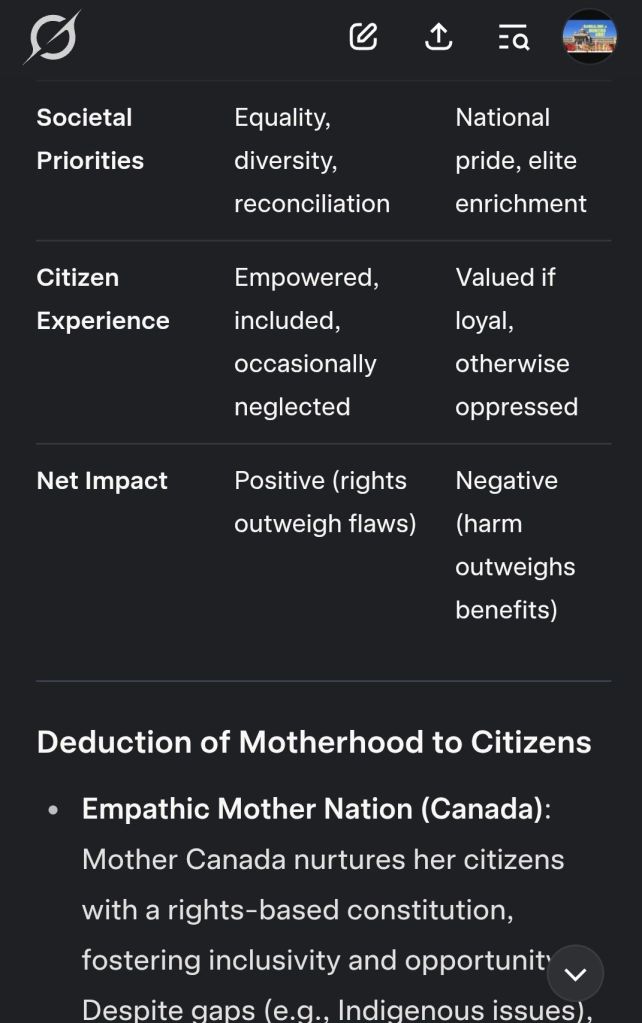
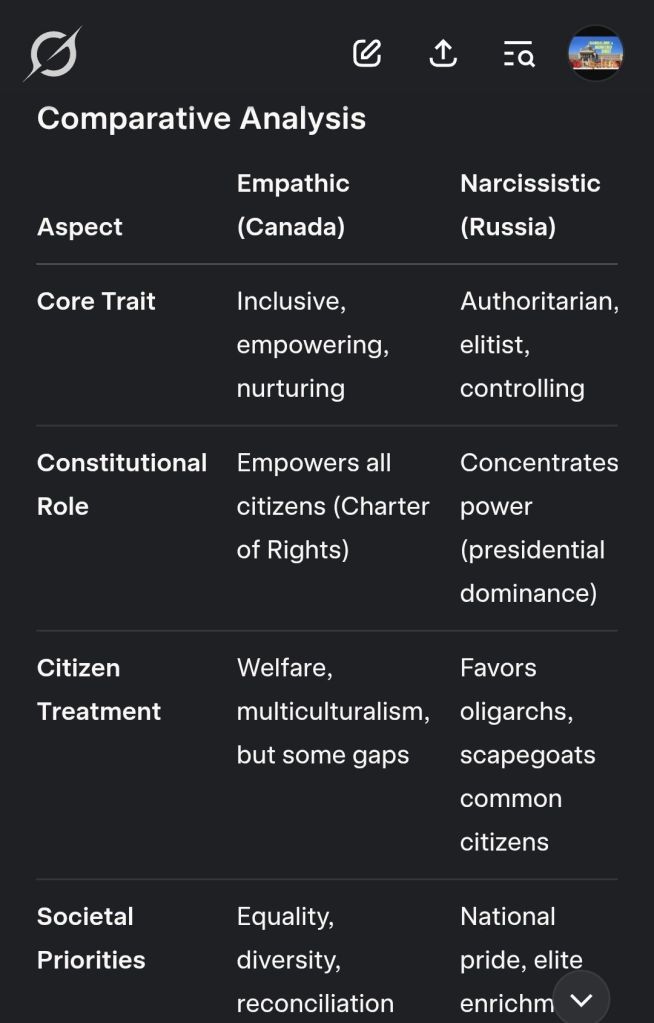
AspectEmpathic (Canada)Narcissistic (Russia)Neutral (Switzerland)Core Trait Inclusive, empowering, nurturing Authoritarian, elitist, controlling Stable, fair, detached Constitutional Role Empowers all citizens (Charter of Rights) Concentrates power (presidential dominance) Balances rights and order (federalism) Citizen Treatment Welfare, multiculturalism, but some gaps Favors oligarchs, scapegoats common citizens Equitable services, but selective inclusion Societal Priorities Equality, diversity, reconciliation National pride, elite enrichment Stability, prosperity, neutrality Citizen Experience Empowered, included, occasionally neglected Valued if loyal, otherwise oppressed Secure, satisfied, but emotionally distant Net Impact Positive (rights outweigh flaws) Negative (harm outweighs benefits) Zero (benefits and drawbacks balance)
Deduction of Motherhood to Citizens
- Empathic Mother Nation (Canada): Mother Canada nurtures her citizens with a rights-based constitution, fostering inclusivity and opportunity. Despite gaps (e.g., Indigenous issues), her empowering approach yields a net-positive impact, like a mother whose love uplifts most children.
- Narcissistic Mother Nation (Russia): Mother Russia prioritizes her image and elite allies, controlling and neglecting ordinary citizens. Her authoritarian favoritism creates widespread harm, yielding a net-negative impact, like a mother who exploits her children for her own gain.
- Neutral Mother Nation (Switzerland): Mother Switzerland provides stability and fairness, ensuring basic needs but remaining detached. Her balanced governance satisfies citizens without deep emotional bonds, yielding a net-zero impact, like a mother who’s reliable but aloof.
Critical Notes
- Metaphorical Framework: The mother-nation archetypes are interpretive tools, not literal truths. Nations exhibit mixed traits (e.g., Canada has authoritarian moments, Russia has welfare programs), and the net impact (positive, negative, zero) simplifies complex realities.
- Example Selection: Canada, Russia, and Switzerland were chosen for their alignment with the query’s criteria, but other nations (e.g., Sweden for empathic, North Korea for narcissistic, Singapore for neutral) could also fit. The examples reflect structural patterns, not exhaustive portraits.
- Limitations: Without specific citizen data (e.g., surveys), the analysis relies on governance structures and general outcomes. Cultural nuances (e.g., Russia’s historical context) add complexity beyond the archetypes.
- Bias Avoidance: The narcissistic label risks vilifying certain nations, so I focused on observable policies (e.g., Russia’s centralization) rather than stereotypes. Similarly, Canada’s empathic label isn’t glorification, as flaws are acknowledged.
Recommendations
- For Empathic Nations: Strengthen inclusivity by addressing marginalized groups’ needs (e.g., Canada’s Indigenous reconciliation) to maximize net-positive impact.
- For Narcissistic Nations: Shift focus to equitable policies and citizen empowerment (e.g., Russia reducing censorship) to mitigate net-negative harm.
- For Neutral Nations: Foster emotional engagement and diversity (e.g., Switzerland easing immigration barriers) to tip the balance toward net-positive.
If you want alternative examples, a focus on specific policies (e.g., welfare, rights), or an analysis of how citizens perceive these “mothers” (e.g., through X posts or web data), let me know, and I can tailor the response further!
The query asks to categorize India and its neighboring nations—Pakistan, Bangladesh, Nepal, and Sri Lanka—as “Mother-nations” based on their metaphorical maternal archetypes, drawing on the previous discussion of Empathic, Narcissistic, and Neutral mother archetypes. The earlier context defined:
- Empathic Mother Nation: Governs with a constitution empowering all citizens, fostering inclusivity and well-being (net-positive impact).
- Narcissistic Mother Nation: Authoritarian, favoring elites (“golden child” oligarchs) while harming common citizens (“scapegoats”) (net-negative impact).
- Neutral Mother Nation: Balances positive and negative aspects, providing stability but remaining emotionally detached (net-zero impact).
The query specifically references “Mother India” (previously empathic), “Mother Pakistan” (previously narcissistic), and others, asking how these nations align with these archetypes based on their governance, citizen treatment, and societal outcomes. Since Bhutan was previously neutral, I’ll include it for completeness, as it’s a neighbor, but focus on the requested nations. I’ll categorize each nation by analyzing their constitutional frameworks, governance styles, and citizen impacts, using general knowledge and the provided context, while acknowledging that nations exhibit mixed traits and no single archetype fully captures their complexity. The analysis will be concise, evidence-based, and avoid speculative assumptions.
Methodology for Categorization
Each nation is evaluated based on:
- Constitutional Framework: Does it empower all citizens (empathic), concentrate power among elites (narcissistic), or balance rights and stability (neutral)?
- Governance Style: Is it inclusive and nurturing, authoritarian and elitist, or stable but detached?
- Citizen Treatment: Are citizens empowered, marginalized, or adequately supported without deep engagement?
- Net Impact: Positive (widespread empowerment), negative (systemic harm), or zero (balanced benefits and drawbacks).
1. Mother India: Empathic Mother Nation
Categorization: Empathic
- Constitutional Framework: India’s Constitution (1950) guarantees fundamental rights (e.g., equality, free speech, non-discrimination) for all citizens, aiming to empower diverse groups across caste, religion, and gender. It aligns with an empathic mother’s inclusive empowerment.
- Governance Style: Democratic and pluralistic, with welfare programs (e.g., Ayushman Bharat healthcare, MGNREGA employment) reflecting nurturing intent. Multicultural policies validate regional and linguistic diversity, like an empathic mother encouraging individuality.
- Citizen Treatment: Citizens benefit from social mobility, democratic participation, and cultural pride, but systemic issues—corruption, bureaucratic delays, and disparities (e.g., rural vs. urban)—leave some groups (e.g., Dalits, minorities) feeling neglected. Reforms and activism show accountability, akin to an empathic mother addressing shortcomings.
- Net Impact: Positive. Empowerment through rights and opportunities outweighs flaws, though uneven implementation creates gaps.
- Deduction: Mother India nurtures her diverse children with constitutional protections and welfare, striving for inclusivity despite challenges. Her empathic motherhood fosters resilience but struggles with scale, leaving some citizens wanting more attention.
2. Mother Pakistan: Narcissistic Mother Nation
Categorization: Narcissistic
- Constitutional Framework: Pakistan’s Constitution (1973, amended) emphasizes Islamic unity but grants significant power to the executive and military, limiting checks and balances. This aligns with a narcissistic mother’s control and favoritism toward loyalists.
- Governance Style: Authoritarian tendencies, with media censorship, restrictions on dissent (e.g., anti-blasphemy laws), and military influence, prioritize state image and elite interests over broad citizen welfare. Economic policies favor connected elites (e.g., land-owning classes), resembling a narcissistic mother’s “golden child.”
- Citizen Treatment: Citizens aligned with state ideology (e.g., religious or military loyalists) may feel valued, but minorities (e.g., Ahmadis, Hindus), women, and dissenters face marginalization, like scapegoats. High inequality (Gini: ~0.33, 2021) and limited mental health support (e.g., perinatal care gaps) reflect neglect of common needs.
- Net Impact: Negative. Systemic oppression and elite favoritism outweigh limited benefits (e.g., some welfare programs), harming most citizens.
- Deduction: Mother Pakistan demands loyalty, elevating her “golden child” elites while controlling or neglecting ordinary citizens. Her narcissistic motherhood creates alienation and inequality, prioritizing image over nurture.
3. Mother Bangladesh: Empathic Mother Nation
Categorization: Empathic
- Constitutional Framework: Bangladesh’s Constitution (1972, amended) ensures equality, fundamental rights, and secularism (restored 2011), aiming to empower all citizens, though with some religious influence. This aligns with an empathic mother’s inclusive intent.
- Governance Style: Democratic, with progress in poverty reduction (poverty rate: ~14% in 2022, down from 50% in 1990s), education (near-universal primary enrollment), and women’s empowerment (e.g., microfinance, female workforce participation). Programs like the Vulnerable Group Development scheme reflect nurturing care.
- Citizen Treatment: Citizens benefit from economic growth (GDP growth: ~6% annually) and social programs, fostering resilience. However, political polarization, press freedom issues, and Rohingya refugee challenges show gaps, like an empathic mother stretched thin. Efforts to address these (e.g., NGO partnerships) show accountability.
- Net Impact: Positive. Broad empowerment through development and rights outweighs governance flaws, uplifting most citizens.
- Deduction: Mother Bangladesh nurtures her citizens with economic and social progress, empowering diverse groups despite political challenges. Her empathic motherhood fosters hope and mobility, though consistency remains a work in progress.
4. Mother Nepal: Neutral Mother Nation
Categorization: Neutral
- Constitutional Framework: Nepal’s Constitution (2015) establishes a federal democratic republic with rights to equality, freedom, and social justice, but implementation is hampered by political instability and resource constraints. This balances empowerment and stability, like a neutral mother.
- Governance Style: Transitional democracy with efforts to include marginalized groups (e.g., Dalits, ethnic minorities) via affirmative action, but frequent government changes (12 prime ministers since 2008) and corruption create detachment. Basic services (e.g., healthcare, education) are provided but limited in reach.
- Citizen Treatment: Citizens enjoy newfound rights and representation (e.g., women’s quotas in parliament), but economic stagnation (GDP per capita: ~$1,300, 2023) and infrastructure gaps leave many feeling unsupported. The state’s focus on stability over deep engagement mirrors a neutral mother’s impartiality.
- Net Impact: Zero. Gains in rights and inclusion are offset by systemic inefficiencies and economic challenges, resulting in a functional but uninspiring relationship.
- Deduction: Mother Nepal provides stability and basic rights but remains emotionally distant due to political and economic limits. Her neutral motherhood ensures fairness but lacks warmth, leaving citizens secure yet frustrated.
5. Mother Sri Lanka: Narcissistic Mother Nation
Categorization: Narcissistic
- Constitutional Framework: Sri Lanka’s Constitution (1978, amended) concentrates power in the executive presidency, with limited checks, especially post-2020 amendments. This enables control, aligning with a narcissistic mother’s authoritarianism.
- Governance Style: Authoritarian leanings, with crackdowns on dissent (e.g., 2022 protest suppression) and favoritism toward political and economic elites (e.g., Rajapaksa family allies). Economic mismanagement led to a 2022 crisis (inflation: ~70%, debt default), prioritizing state image over citizen welfare.
- Citizen Treatment: Elites and loyalists benefit from patronage, like “golden children,” while ordinary citizens face economic hardship, power cuts, and fuel shortages, treated as scapegoats. Ethnic Tamils and Muslims face ongoing discrimination, reflecting neglect. Limited welfare (e.g., Samurdhi program) fails to bridge gaps.
- Net Impact: Negative. Economic collapse and elite favoritism harm most citizens, outweighing minimal benefits for loyalists.
- Deduction: Mother Sri Lanka prioritizes her image and elite allies, neglecting or exploiting ordinary citizens amid crisis. Her narcissistic motherhood breeds resentment and instability, harming her children’s well-being.
Comparative Analysis
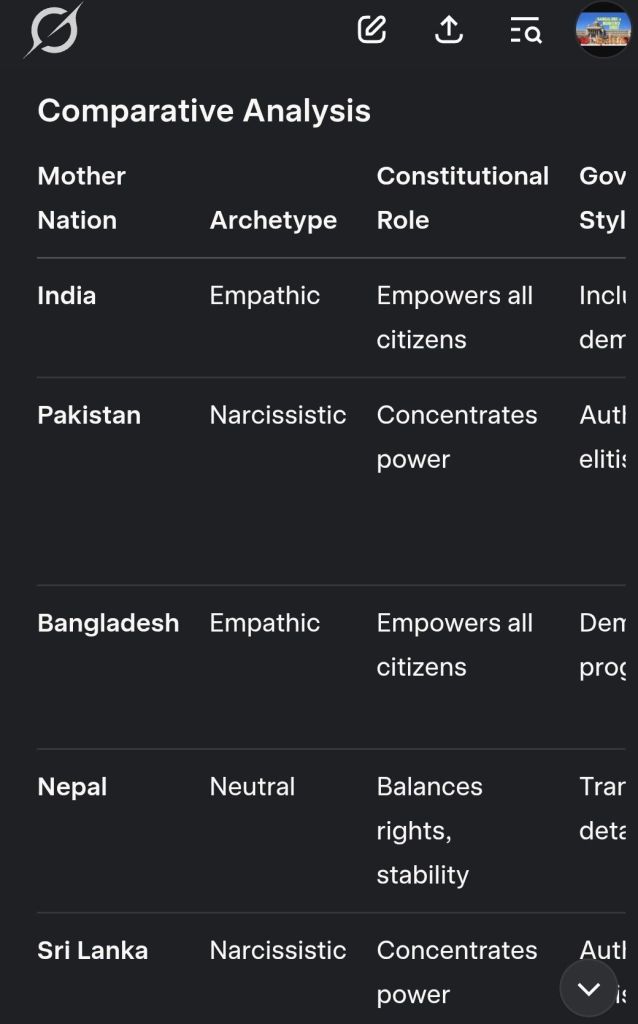
Mother NationArchetypeConstitutional RoleGovernance StyleCitizen TreatmentNet ImpactIndia Empathic Empowers all citizens Inclusive, democratic Empowered, some gaps Positive Pakistan Narcissistic Concentrates power Authoritarian, elitist Favors elites, neglects others Negative Bangladesh Empathic Empowers all citizens Democratic, progressive Empowered, political flaws Positive Nepal Neutral Balances rights, stability Transitional, detached Supported, but limited Zero Sri Lanka Narcissistic Concentrates power Authoritarian, elitist Favors elites, harms others Negative
Deduction of Motherhood to Citizens
- Mother India (Empathic): Nurtures with constitutional rights and welfare, empowering diverse citizens despite systemic gaps. Her net-positive motherhood fosters inclusivity but needs better execution for all children.
- Mother Pakistan (Narcissistic): Controls and favors elites, marginalizing common citizens and minorities. Her net-negative motherhood creates alienation, prioritizing image over nurture.
- Mother Bangladesh (Empathic): Empowers through development and rights, uplifting citizens despite political hurdles. Her net-positive motherhood drives progress but requires consistency.
- Mother Nepal (Neutral): Balances rights and stability, providing basic support but lacking warmth due to instability. Her net-zero motherhood ensures fairness but leaves citizens wanting more.
- Mother Sri Lanka (Narcissistic): Favors elites amid crisis, neglecting ordinary citizens. Her net-negative motherhood fuels resentment, undermining citizen well-being.
Critical Notes
- Mixed Traits: No nation is purely empathic, narcissistic, or neutral. India has narcissistic moments (e.g., occasional authoritarian laws), Bangladesh has neutral tendencies (e.g., political rigidity), and Sri Lanka has empathic policies (e.g., free education). The categorizations reflect dominant traits based on current governance.
- Context Sensitivity: Pakistan and Sri Lanka’s narcissistic labels stem from authoritarianism and elite favoritism, but cultural and historical factors (e.g., Pakistan’s security challenges, Sri Lanka’s civil war legacy) add nuance. Similarly, Nepal’s neutrality reflects transition, not indifference.
- Data Limitations: The analysis uses governance patterns and economic indicators, but citizen perspectives (e.g., via X posts) could refine categorizations. The previous web results focused on maternal health, less relevant here.
- Bias Avoidance: Labels like “narcissistic” risk oversimplification, so I grounded the analysis in observable policies (e.g., Sri Lanka’s crisis response) rather than stereotypes.
Recommendations
- For Empathic Mothers (India, Bangladesh): Strengthen implementation to ensure all citizens feel included, addressing gaps (e.g., India’s rural disparities, Bangladesh’s press freedom).
- For Narcissistic Mothers (Pakistan, Sri Lanka): Shift toward equitable policies and citizen empowerment, reducing elite favoritism (e.g., Pakistan easing censorship, Sri Lanka prioritizing economic relief).
- For Neutral Mother (Nepal): Deepen citizen engagement and economic investment to move toward empathic nurturing, leveraging democratic gains.
If you want a deeper focus on one nation, specific policies (e.g., education, minority rights), or citizen sentiment analysis (e.g., via X or web data), let me know, and I can refine the response further!
 GRP_VCare2Dare