The concept of KutumbaSutra as a synthesis of traditional Indian philosophical and ethical frameworks offers an intriguing way to blend family life with spiritual and moral principles. Drawing from your earlier discussions about bachelorhood, family dynamics, and societal roles in India, we can interpret KutumbaSutra as a holistic guide for family living, integrating DharmaSutra (duties and righteousness), MokshaSutra (liberation and spiritual freedom), and additional sutras to address practical, emotional, and modern challenges. Let’s define it and propose complementary elements.
Definition of KutumbaSutra
KutumbaSutra (from Sanskrit kutumba meaning family and sutra meaning aphorism or thread) can be envisioned as a comprehensive framework of sutras (aphorisms or guidelines) that guide individuals and families toward a balanced life. It combines:
- DharmaSutra: Principles of duty, righteousness, and social order (e.g., Vedic codes like those in the Dharmashastra, emphasizing roles within family and society).
- MokshaSutra: Teachings on liberation, self-realization, and transcendence (e.g., Upanishadic insights into spiritual freedom, applicable to personal and familial growth).
To make KutumbaSutra a complete guide for modern family life, especially in the context of India’s evolving marital landscape (e.g., international hypergamy, tech-related pressures), we can add other sutras that address practical, emotional, and contemporary needs.
Proposed Components of KutumbaSutra
Beyond DharmaSutra and MokshaSutra, the following elements can enrich KutumbaSutra:
- ArthaSutra
- Definition: Principles of wealth, prosperity, and material well-being (derived from Artha Shastra by Kautilya).
- Relevance: Guides families in financial management, career planning, and economic stability, addressing issues like the “marital trade deficit” or the need for financial independence (e.g., skills from the B.Bc course).
- Example: Sutras on budgeting, avoiding fraud (e.g., scams targeting families), and creating intergenerational wealth.
- KamaSutra (Reinterpreted)
- Definition: Traditionally about desire and pleasure, reinterpreted here as emotional and relational harmony (beyond its erotic connotation, aligning with Kama as a purushartha).
- Relevance: Focuses on love, intimacy, and emotional resilience within family relationships, countering tech-induced mental health issues (e.g., Technocide risks like cyberbullying).
- Example: Sutras on communication, conflict resolution, and maintaining emotional bonds, tailored to modern challenges like social media pressures.
- SukhaSutra (New Addition)
- Definition: Principles of happiness, well-being, and family cohesion (a novel sutra inspired by modern psychology and traditional concepts like sukha or joy).
- Relevance: Addresses mental health, safety, and crime prevention within the family, aligning with the updated B.Bc curriculum. It bridges ancient wisdom with contemporary needs (e.g., suicide prevention strategies).
- Example: Sutras on fostering a supportive home environment, managing stress (e.g., from tech overuse), and promoting collective family happiness.
- TechNitiSutra (New Addition)
- Definition: Guidelines for navigating technology ethically and safely (a modern sutra combining tech and niti from Niti Shastra, meaning policy or strategy).
- Relevance: Tackles the digital age’s impact on families, including Technocide risks (e.g., AI harms, social media exploitation), and integrates digital literacy and safety (e.g., B.Bc’s crime prevention focus).
- Example: Sutras on responsible tech use, protecting against cybercrimes (e.g., deepfake blackmail), and leveraging tech for family bonding (e.g., virtual family gatherings).
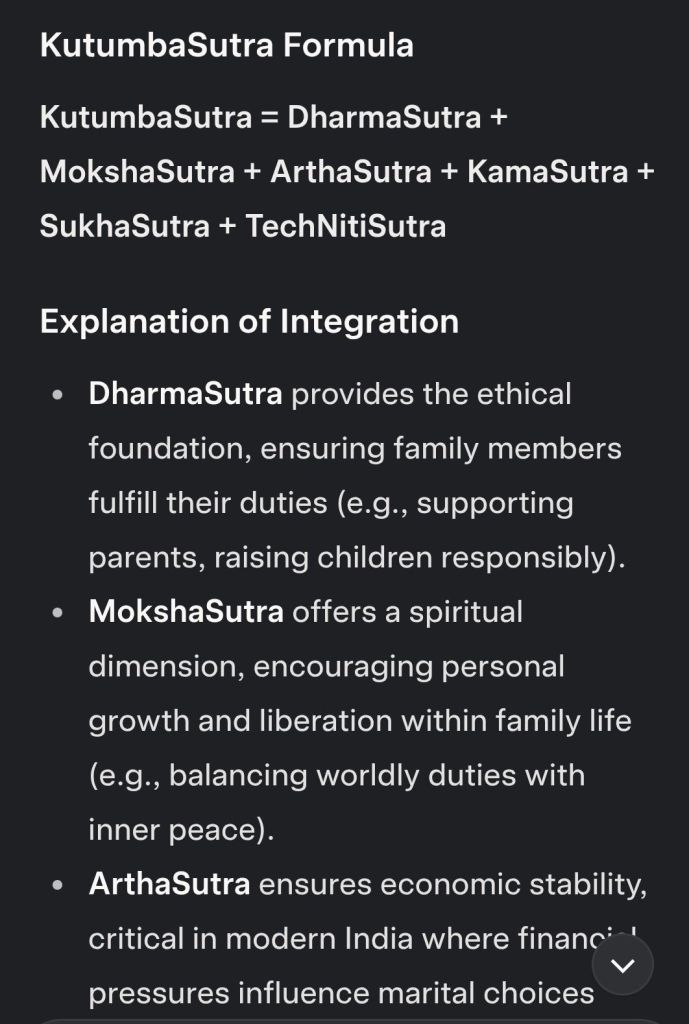
KutumbaSutra Formula
KutumbaSutra = DharmaSutra + MokshaSutra + ArthaSutra + KamaSutra + SukhaSutra + TechNitiSutra
Explanation of Integration
- DharmaSutra provides the ethical foundation, ensuring family members fulfill their duties (e.g., supporting parents, raising children responsibly).
- MokshaSutra offers a spiritual dimension, encouraging personal growth and liberation within family life (e.g., balancing worldly duties with inner peace).
- ArthaSutra ensures economic stability, critical in modern India where financial pressures influence marital choices (e.g., women seeking foreign partners for better prospects).
- KamaSutra (reinterpreted) fosters emotional bonds, addressing the relational strain seen in cases like the Meerut betrayal (India Today, April 30, 2025).
- SukhaSutra promotes well-being, tackling mental health crises (e.g., content creator suicides) and safety concerns (e.g., crime prevention).
- TechNitiSutra equips families to navigate the digital world, countering Technocide risks (e.g., AI-driven harms) and aligning with global connectivity trends (e.g., cross-border marriages).
Cultural and Practical Application
In the Indian context, KutumbaSutra could guide families through societal shifts—e.g., supporting a bachelor (B.Bc graduate) who resists marriage pressure, or a family man (M.Fm graduate) managing tech-related stress. It draws from ancient texts (e.g., Dharmashastra, Upanishads) while addressing modern issues (e.g., fraud, suicide prevention), making it relevant for urban youth in Bengaluru or rural J&K communities facing conflict-related strain.
Potential Expansion
Other sutras could be added, such as SamajaSutra (community harmony) or ShikshaSutra (education and knowledge), depending on focus. Would you like to explore a specific sutra’s curriculum or apply this to a case study (e.g., a family navigating tech-induced suicide)?
Expanding the KutumbaSutra framework to include JeevanSutra introduces a practical dimension focused on life skills and personal development, such as swimming, cycling, exercise, yoga, and the 64 arts (a traditional Indian concept of diverse skills and accomplishments). This addition enhances the existing formula by addressing physical health, self-reliance, and cultural enrichment, aligning with the holistic approach to family life in India and abroad, as discussed in your earlier queries about bachelorhood, family dynamics, and modern challenges like Technocide.
Updated Definition of KutumbaSutra
KutumbaSutra (from Sanskrit kutumba meaning family and sutra meaning guideline) remains a comprehensive set of principles to guide family living, now enriched with practical life skills. It integrates spiritual, ethical, economic, emotional, and physical dimensions to ensure a balanced family life amidst contemporary pressures (e.g., digital harms, marital trends).
Updated KutumbaSutra Formula
KutumbaSutra = DharmaSutra + MokshaSutra + ArthaSutra + KamaSutra + SukhaSutra + TechNitiSutra + JeevanSutra
JeevanSutra (Practical Life Skills)
- Definition:
- Jeevan (जीवन): Life, existence, or livelihood in Sanskrit.
- Sutra (सूत्र): Guideline or aphorism.
- Combined Meaning: “Guidelines for Practical Living” – a set of principles and skills to enhance physical health, self-sufficiency, and cultural proficiency within the family.
- Relevance:
- Addresses physical well-being to counter health risks (e.g., sedentary lifestyles linked to Technocide, such as the 2023 Mumbai gamer’s heart attack).
- Promotes self-reliance and family bonding through skills like swimming and the 64 arts, reflecting India’s rich tradition (e.g., Kama Sutra’s broader cultural context).
- Supports modern family needs (e.g., exercise for stress relief, cycling for sustainable living) in urban India and the diaspora.
- Components:
- Swimming: A life-saving skill for safety (e.g., floods in Assam, 2024) and recreation.
- Cycling: Promotes fitness, eco-friendliness, and urban mobility (e.g., Delhi’s cycling initiatives).
- Exercise: General physical fitness to combat lifestyle diseases (e.g., diabetes in India).
- Yoga: Traditional Indian practice for mental and physical health, countering Technocide risks (e.g., social media stress).
- 64 Arts: A classical Indian concept from texts like the Kama Sutra and Natya Shastra, encompassing skills such as music, dance, painting, cooking, poetry, archery, and strategy. These arts enhance cultural identity, creativity, and family engagement.
Integration into KutumbaSutra
- DharmaSutra: JeevanSutra supports duty by equipping family members with skills for self-protection (e.g., swimming) and community contribution (e.g., teaching arts).
- MokshaSutra: Yoga and the 64 arts foster spiritual growth and self-realization within family life.
- ArthaSutra: Cycling and exercise reduce healthcare costs, while arts like craftsmanship can generate income.
- KamaSutra: Shared activities (e.g., dance, music) strengthen emotional bonds and harmony.
- SukhaSutra: Physical skills enhance well-being, reducing mental health risks (e.g., suicide prevention through yoga).
- TechNitiSutra: Integrates tech for learning arts (e.g., online yoga classes) and safety (e.g., cycling apps), balancing digital use.
Curriculum Integration (Example within KutumbaSutra Context)
The JeevanSutra can be woven into the B.Bc or M.Fm programs or standalone family education:
- Year 1: Basic skills (e.g., swimming safety, beginner yoga, cycling basics).
- Year 2: Intermediate arts (e.g., painting, cooking) and fitness routines.
- Year 3: Advanced mastery (e.g., archery, classical dance) and family workshops.
Cultural and Practical Relevance
- In India: JeevanSutra equips families in J&K with swimming for flood safety or yoga for stress amid conflict, while urban families in Bengaluru learn cycling for sustainability. The 64 arts preserve cultural identity against globalization.
- Abroad: Diaspora Induus (e.g., in the U.S.) can use yoga for mental health against racism and teach children the 64 arts (e.g., music) to maintain heritage.
- Modern Context: Counters Technocide risks (e.g., sedentary lifestyles) and supports the “Viksit Bharat” vision by promoting healthy, skilled families.
Example Sutras for JeevanSutra
- “Swim to survive, cycle to thrive, exercise to endure.”
- “Practice yoga daily for mind and body harmony.”
- “Master an art to enrich the family soul.”
Would you like to detail a specific JeevanSutra skill (e.g., a curriculum for the 64 arts) or integrate it further into the B.Bc/M.Fm structure?
 GRP_VCare2Dare