Below is a 10-question test designed to assess how secular or religious a citizen is in their daily interactions, behaviors, and attitudes, focusing on the concept of Citizen-Secularism (as described in the previous response). The test evaluates your approach to voting, fraternity, trading, and relating, with a scoring system to determine your secularity score.
How Secular Are You? Citizen Secularity Test
This 10-question test measures your level of Citizen-Secularism, which reflects how you practice secular values in daily life, including voting, social interactions, trading, and fostering fraternity. Answer each question honestly, and tally your score at the end to find your secularity level.
Instructions
- For each question, choose the option that best reflects your behavior or attitude.
- Each option has a point value (0–4). Add up your points at the end.
- Higher scores indicate stronger secular tendencies; lower scores suggest more religious influence in your actions.
Questions
- When voting in elections, what primarily influences your choice?
- a) The candidate’s policies and track record, regardless of their religion (4 points)
- b) A mix of policies and whether their values align with my beliefs (3 points)
- c) Their alignment with my religious or cultural values (2 points)
- d) Their religious identity or affiliation (1 point)
- e) I don’t vote or consider religion irrelevant to voting (0 points)
- How often do you participate in interfaith or secular community events (e.g., mixed-religion festivals, neighborhood cleanups)?
- a) Regularly, I actively seek them out (4 points)
- b) Occasionally, when invited or convenient (3 points)
- c) Rarely, I prefer events tied to my beliefs (2 points)
- d) Never, I only attend religious-specific events (1 point)
- e) I don’t participate in community events (0 points)
- When choosing where to shop or do business, how much does the owner’s religion matter?
- a) Not at all, I focus on quality and price (4 points)
- b) Slightly, but it’s not a major factor (3 points)
- c) Moderately, I prefer businesses tied to my beliefs (2 points)
- d) Significantly, I only support businesses of my faith (1 point)
- e) I don’t consider this as I don’t shop locally (0 points)
- How do you approach friendships or social relationships with people of different religions?
- a) I actively build and maintain diverse friendships (4 points)
- b) I’m open to them, but most friends share my beliefs (3 points)
- c) I’m cautious and prefer friends of similar faith (2 points)
- d) I only form close bonds with people of my religion (1 point)
- e) I avoid close relationships altogether (0 points)
- How do you react to religious diversity in your workplace or school?
- a) I embrace it and learn from others’ perspectives (4 points)
- b) I’m neutral and treat everyone equally (3 points)
- c) I’m respectful but keep my distance from differing beliefs (2 points)
- d) I feel uncomfortable and stick to my religious group (1 point)
- e) I don’t interact in diverse settings (0 points)
- When discussing politics or social issues, how much do your religious beliefs guide your views?
- a) Not at all, I focus on reason and evidence (4 points)
- b) Slightly, but I prioritize universal values (3 points)
- c) Moderately, my faith shapes many of my views (2 points)
- d) Completely, my religion is central to my opinions (1 point)
- e) I avoid such discussions (0 points)
- How do you view interfaith marriages or relationships?
- a) I fully support them and see them as positive (4 points)
- b) I’m neutral, it depends on the individuals (3 points)
- c) I’m skeptical, they can be challenging (2 points)
- d) I oppose them, they conflict with my beliefs (1 point)
- e) I have no opinion on this (0 points)
- How often do you advocate for or support secular policies (e.g., equal treatment of all religions, neutral public spaces)?
- a) Actively, through voting or activism (4 points)
- b) Occasionally, when the issue arises (3 points)
- c) Rarely, I focus on my community’s needs (2 points)
- d) Never, I support policies tied to my faith (1 point)
- e) I don’t engage with policy issues (0 points)
- When attending cultural or religious events of other faiths, how do you feel?
- a) Excited and curious to learn (4 points)
- b) Comfortable but neutral (3 points)
- c) Uneasy but respectful (2 points)
- d) Uncomfortable, I avoid such events (1 point)
- e) I never attend such events (0 points)
- How do you handle conflicts or disagreements involving religious differences?
- a) I seek dialogue and mutual understanding (4 points)
- b) I stay respectful but avoid deep discussion (3 points)
- c) I defend my beliefs but remain civil (2 points)
- d) I argue strongly for my religious perspective (1 point)
- e) I avoid such conflicts entirely (0 points)
Scoring
- Add up your points from all 10 questions.
- Maximum score: 40 (highly secular)
- Minimum score: 0 (minimal engagement with secularism)
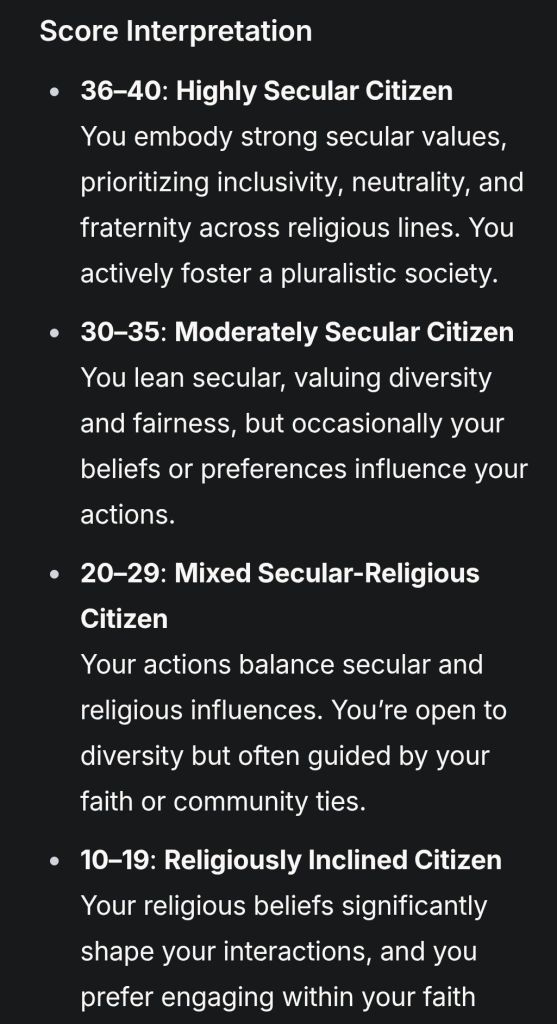
Score Interpretation
- 36–40: Highly Secular Citizen
You embody strong secular values, prioritizing inclusivity, neutrality, and fraternity across religious lines. You actively foster a pluralistic society. - 30–35: Moderately Secular Citizen
You lean secular, valuing diversity and fairness, but occasionally your beliefs or preferences influence your actions. - 20–29: Mixed Secular-Religious Citizen
Your actions balance secular and religious influences. You’re open to diversity but often guided by your faith or community ties. - 10–19: Religiously Inclined Citizen
Your religious beliefs significantly shape your interactions, and you prefer engaging within your faith community. - 0–9: Non-Engaged or Strongly Religious Citizen
You either avoid diverse interactions or prioritize your religious identity exclusively, with minimal secular engagement.
Takeaways
- A higher score reflects stronger alignment with Citizen-Secularism, emphasizing behaviors that promote equality, inclusivity, and neutrality in daily life.
- A lower score may indicate a preference for religious or community-specific interactions, which can still coexist with respect for others.
- Reflect on your results to understand how your actions contribute to a secular or pluralistic society!
 GRP_VCare2Dare