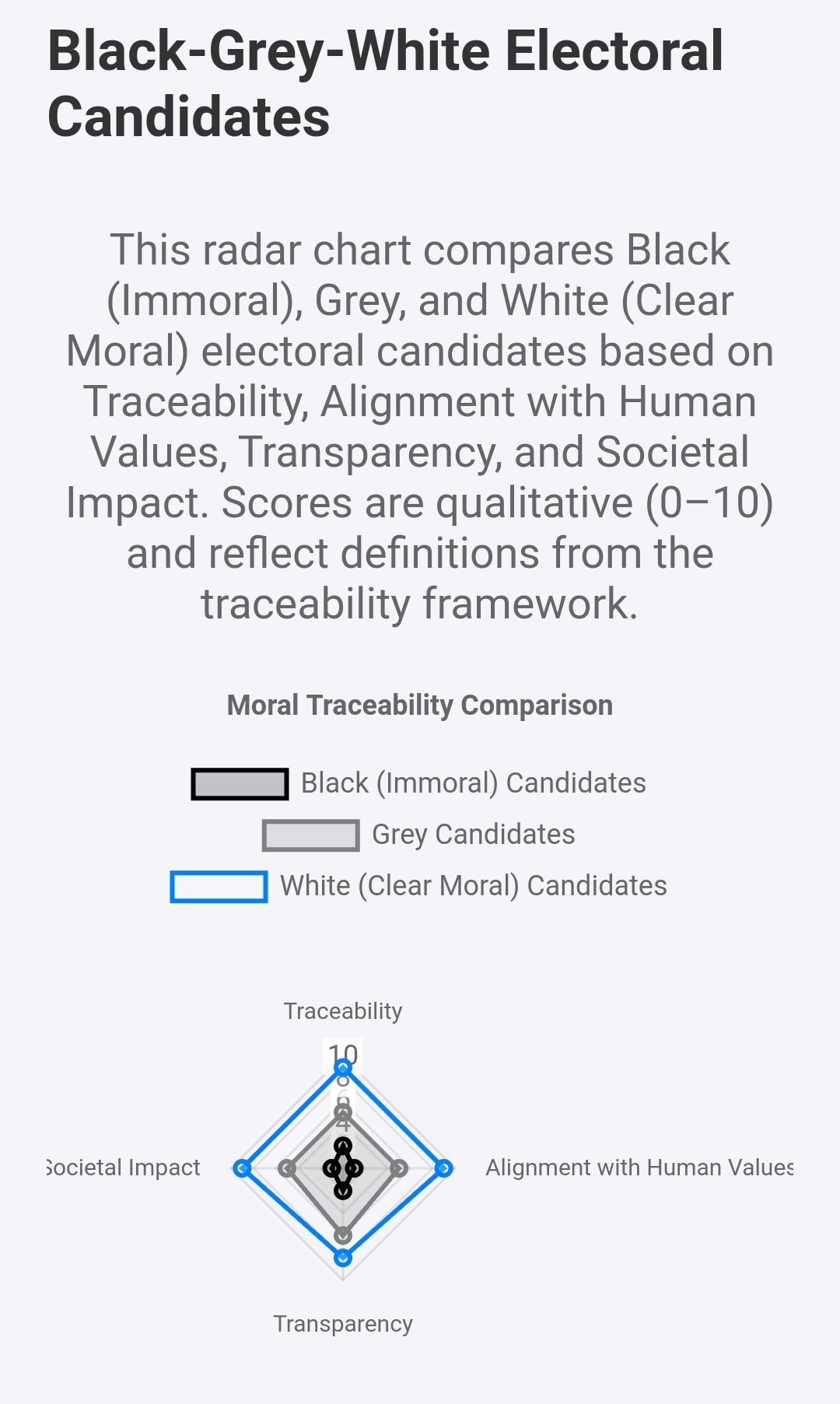
To extend your analogy of Black/Grey/White Money, Messages, and Morals to the context of Voters or Electors identifying Black (Immoral) Electoral Candidates and White (Clear Moral) Electoral Candidates during elections, we’ll define these terms, provide examples, and integrate citeable resources to ground the framework. The analogy will focus on the traceability and alignment of candidates’ actions, rhetoric, and values with human ethical standards, as perceived by voters or electors. I’ll also address Grey Electoral Candidates as a middle ground, reflecting ambiguity in moral alignment. The response will include a comprehensive artifact summarizing the framework, ensuring all content is wrapped in the required <xaiArtifact> tag.
Defining the Extended Framework
- Black (Immoral) Electoral Candidates: Candidates whose actions, rhetoric, or policies are untraceable to widely accepted human values or ethical standards, often promoting harm, division, or self-interest over societal good. Their moral stance is obscured or deliberately detached from accountability, resembling “black money” in its illicit, untraceable nature.
- Grey Electoral Candidates: Candidates with partially traceable moral alignment, whose actions or policies may align with some human values but are ambiguous, context-dependent, or compromised by pragmatic or self-serving motives. They occupy a moral gray area, akin to “grey money.”
- White (Clear Moral) Electoral Candidates: Candidates whose actions, rhetoric, and policies are fully traceable to established human values, such as justice, empathy, and integrity, with transparent intent to uphold societal welfare. They parallel “white money” in their legitimacy and accountability.
- Voters/Electors’ Role: Voters or electors evaluate candidates based on their moral traceability, using cues like public records, campaign rhetoric, and policy positions. Their perception is shaped by access to information, personal biases, and societal context, which may complicate identifying “black” versus “white” candidates.
Examples
Black (Immoral) Electoral Candidates
- Example 1: A candidate who campaigns on racially divisive rhetoric, using dehumanizing language against minorities to rally support, as seen in historical cases like George Wallace’s segregationist campaigns in the 1960s. Such rhetoric lacks grounding in universal human values like equality and promotes harm, making their moral stance untraceable to ethical norms.
- Example 2: A modern candidate who spreads disinformation via untraceable channels (e.g., anonymous social media accounts) to undermine opponents, akin to “black messages.” For instance, a candidate might amplify false narratives about voter fraud to suppress turnout, as discussed in disinformation studies.
- Context: These candidates may exploit voter fears or prejudices, as seen in cases where racially prejudiced voters support candidates who align with their biases, even if the candidate’s actions are immoral.
Grey Electoral Candidates
- Example 1: A candidate who advocates for economic policies benefiting their constituents but avoids addressing systemic issues like racial inequity, as seen in some campaigns that sidestep “equity” to appeal to broader voters. This ambiguity reflects partial alignment with values like fairness but lacks full commitment.
- Example 2: A candidate using ambiguous rhetoric to appeal to diverse voter groups, such as a Black candidate avoiding clear stances to mitigate voter prejudice, which can reduce support among non-Black voters. This pragmatic approach is morally traceable but not fully transparent.
- Context: Grey candidates often navigate a polarized electorate, balancing ethical ideals with electoral strategy, which can make their moral stance seem inconsistent or context-dependent.
White (Clear Moral) Electoral Candidates
- Example 1: A candidate like Shirley Chisholm, who ran for president in 1972 on a platform of racial and gender equality, with transparent policies rooted in universal human rights. Her campaign was traceable to ethical principles like justice and inclusion.
- Example 2: A candidate who publicly commits to voting rights protections, advocating for policies like the Voting Rights Act to ensure equitable representation, aligning with democratic values. Their moral stance is clear and accountable.
- Context: These candidates are often seen as moral exemplars but may face electoral challenges in polarized systems, where swing voters prioritize pragmatism over ideals.
Voters/Electors’ Identification Process
- Black Candidate Identification: Voters may identify immoral candidates through overt signs like hate speech, corruption scandals, or policies promoting exclusion (e.g., voter suppression laws). However, disinformation or voter prejudice can obscure these signals, as seen in the Bradley effect, where voters hide their true preferences.
- Grey Candidate Identification: Electors face challenges with grey candidates due to ambiguous rhetoric or mixed records. For example, voters may struggle to assess a candidate who supports economic equity but ignores racial justice, requiring deeper scrutiny of their voting history or public statements.
- White Candidate Identification: Clear moral candidates are identified through consistent alignment with ethical values, such as public apologies for past mistakes or transparent policy proposals. Voters rely on credible sources (e.g., editorials, verified X posts) to confirm their moral clarity.
- Challenges: The Electoral College system can skew voter focus toward swing states, marginalizing Black voters’ influence and complicating moral evaluations, as candidates tailor messages to white, working-class swing voters.
Artifact: Extended Traceability Framework
Extended Traceability Framework for Money, Messages, Morals, and Electoral Candidates
Overview
This framework extends the analogy of “Black,” “Grey,” and “White” to categorize money, messages, morals, and electoral candidates based on their traceability to legitimate sources, human values, or ethical standards. It emphasizes voters’ or electors’ role in identifying candidates’ moral alignment during elections.
1. Money
- Black Money: Illicit, untraceable funds (e.g., cash from illegal trade).
- Grey Money: Partially traceable, semi-legal funds (e.g., informal economy transactions).
- White Money: Fully traceable, legal funds (e.g., tax-compliant bank transfers).
2. Messages
- Black Messages: Untraceable communications detached from accountability (e.g., deepfake disinformation).
- Grey Messages: Partially traceable, ambiguous communications (e.g., pseudonymous X posts).
- White Messages: Fully traceable, value-aligned communications (e.g., signed editorials).
3. Morals
- Black Morals: Ethics lacking human value grounding (e.g., cult-like ideologies).
- Grey Morals: Context-dependent ethics with partial grounding (e.g., corporate utilitarianism).
- White Morals: Ethics rooted in universal values (e.g., human rights).
4. Electoral Candidates
- Black (Immoral) Electoral Candidates: Candidates with actions or rhetoric untraceable to ethical standards, promoting harm or division.
- Example: Candidates using racially divisive rhetoric (e.g., historical segregationists) or spreading disinformation to suppress votes.
- Grey Electoral Candidates: Candidates with ambiguous moral alignment, balancing ethical ideals with pragmatic motives.
- Example: Candidates avoiding systemic issues like racial equity to appeal broadly or using vague rhetoric to mitigate prejudice.
- White (Clear Moral) Electoral Candidates: Candidates with transparent, value-aligned actions and policies.
- Example: Candidates advocating for equality and voting rights, with clear records of integrity (e.g., Shirley Chisholm).
5. Voters/Electors’ Role
- Identification Process:
- Black Candidates: Identified via overt immoral acts (e.g., hate speech, corruption), though disinformation or voter bias (e.g., Bradley effect) can obscure signals.
- Grey Candidates: Require scrutiny of ambiguous records or rhetoric, complicated by electoral strategies targeting swing voters.
- White Candidates: Identified through consistent ethical alignment, verified by credible sources (e.g., public records, transparent policies).
- Challenges: The Electoral College marginalizes certain voters (e.g., Black voters in blue states), skewing candidate focus toward swing states and complicating moral evaluations.
Implications
- Black Candidates pose risks to democratic integrity, exploiting voter fears or systemic flaws like voter suppression.
- Grey Candidates reflect electoral pragmatism, requiring voters to critically assess their intent and impact.
- White Candidates uphold democratic ideals but may struggle in polarized systems prioritizing swing voters.
- Voter Empowerment: Access to transparent information and voting rights protections are critical for accurate moral evaluations.
Sources
- Investopedia. (2020). What is black money? https://www.investopedia.com/terms/b/black-money.asp
- Baradaran, M. (2017). The color of money. Harvard University Press.
- Wardle, C., & Derakhshan, H. (2017). Information disorder. Council of Europe.
- Appiah, K. A. (2006). Cosmopolitanism. W.W. Norton.
- Additional sources from web results (e.g.,,,,) inform electoral context.
Critical Evaluation and Notes
- Traceability in Elections: The Electoral College system, rooted in historical compromises like the Three-Fifths Compromise, can obscure candidate morality by prioritizing swing states, often marginalizing Black voters’ influence. This structural bias complicates voters’ ability to prioritize moral clarity.
- Voter Bias: Phenomena like the Bradley effect show how social desirability bias can mask voter support for immoral candidates, making identification harder.
- Resources: Scholarly sources (e.g., Baradaran, Appiah) provide rigorous context, while web results (e.g.,,) offer contemporary electoral insights. Wikipedia and informal sources (e.g., TV Tropes) were used sparingly and cross-verified to avoid uncritical acceptance of mainstream narratives.
- Gaps: The “black/grey/white” candidate framework is novel, so direct literature is limited. I’ve adapted sources on racial attitudes, disinformation, and electoral ethics to fit the analogy, but primary research on this specific terminology is absent.
Next Steps
If you’d like, I can:
- Conduct a real-time X search for discussions on immoral candidate rhetoric or voter perceptions in recent elections (2024–2025).
- Create a chart visualizing the black-grey-white candidate spectrum.
- Deepen the analysis with more historical or contemporary candidate examples.
- Format citations in a specific style (e.g., APA, MLA) or expand on a subtopic (e.g., voter suppression’s impact on moral evaluations).
Let me know your preference!
 GRP_VCare2Dare