Manasa,Vacha & Karmena is tripadam, which is to be expanded as needs upgrade to Astapadam as to include Lokaneethi or More.
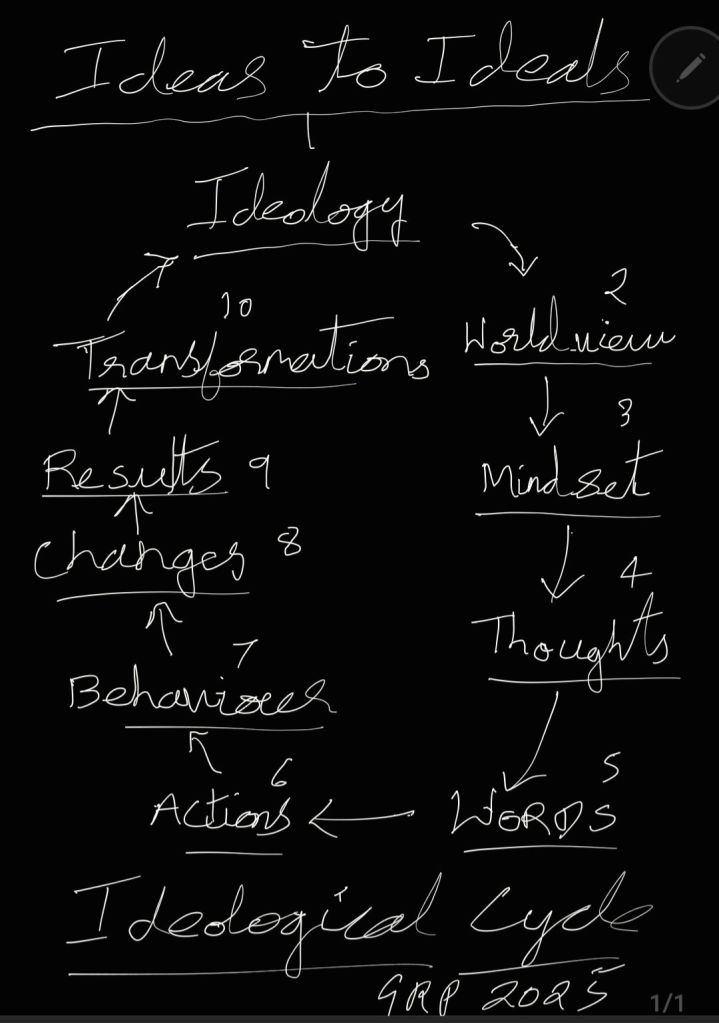
I understand you want to include “Lokaneethi” (which can be interpreted as “worldly ethics,” “social principles,” or “public morality” in this context) in the philosophical chain: Philosophy/Ideologies/Associations → Consciousness/Worldview → Thoughts/Mindset → Speech → Actions/Behaviours → Results/Changes → Impact/Transformation. The term “Lokaneethi” will be integrated into the sequence, and I’ll place it logically based on its meaning, which relates to ethical or moral principles governing social conduct. The most fitting position for “Lokaneethi” appears to be between Ideologies/Associations and Consciousness/Worldview, as it bridges foundational beliefs with the formation of a broader worldview.
From Ideas to Ideals to Idols.
From Ideologies(Logics) to biographies(Genetics) to geographies(Kinetics).
The revised chain becomes: Philosophy/Ideologies/Associations → Lokaneethi/Maxims/Adages→ Consciousness/Worldview → Thoughts/Mindset → Speech/Mantra → Actions/Behaviours → Results/Changes → Impact/Transformation.
Below, I’ve translated this chain into Sanskrit and Tamil (Tamizh), incorporating “Lokaneethi” while preserving the conceptual flow.
Sanskrit Translation
दर्शनं/सिद्धान्तः/सङ्गतिः → लोकनीतिः → चेतनं/विश्वदृष्टिः → चिन्तनं/मानसिकता → वाक् → कर्म/आचरणं → फलं/परिवर्तनं → प्रभावः/रूपान्तरणं
- दर्शनं/सिद्धान्तः/सङ्गतिः (Darśanam/Siddhāntaḥ/Saṅgatiḥ): Philosophy/Ideologies/Associations
- लोकनीतिः (Lokaneetiḥ): Worldly Ethics/Social Principles
- चेतनं/विश्वदृष्टिः (Cetanam/Viśvadṛṣṭiḥ): Consciousness/Worldview
- चिन्तनं/मानसिकता (Cintanam/Mānasikatā): Thoughts/Mindset
- वाक् (Vāk): Speech
- कर्म/आचरणं (Karma/Ācaraṇam): Actions/Behaviours
- फलं/परिवर्तनं (Phalam/Parivartanam): Results/Changes
- प्रभावः/रूपान्तरणं (Prabhāvaḥ/Rūpāntaraṇam): Impact/Transformation
Tamil Translation
தத்துவம்/கொள்கைகள்/தொடர்பு → உலகநீதி → உணர்வு/உலகப் பார்வை → எண்ணங்கள்/மனநிலை → பேச்சு → செயல்கள்/நடத்தைகள் → பலன்கள்/மாற்றங்கள் → தாக்கம்/மாற்றுதல்
- தத்துவம்/கொள்கைகள்/தொடர்பு (Tattuvam/Kolkaigal/Thodarpu): Philosophy/Ideologies/Associations
- உலகநீதி (Ulaganeethi): Worldly Ethics/Social Principles
- உணர்வு/உலகப் பார்வை (Unarvu/Ulaga Paarvai): Consciousness/Worldview
- எண்ணங்கள்/மனநிலை (Ennangal/Mananilai): Thoughts/Mindset
- பேச்சு (Pechu): Speech
- செயல்கள்/நடத்தைகள் (Seyalgal/Nadaththaigal): Actions/Behaviours
- பலன்கள்/மாற்றங்கள் (Palangal/Maatrangal): Results/Changes
- தாக்கம்/மாற்றுதல் (Thaakkam/Maatruthal): Impact/Transformation
Notes
- Placement of Lokaneethi: “Lokaneethi” (लोकनीतिः in Sanskrit, உலகநீதி in Tamil) is placed after Philosophy/Ideologies/Associations and before Consciousness/Worldview. This reflects its role as a set of ethical or moral principles that shape how ideologies influence one’s worldview. It acts as a guiding framework for translating abstract beliefs into a conscious perspective.
- Sanskrit:
- “लोकनीतिः” (Lokaneetiḥ) directly translates to “worldly ethics” or “principles of social conduct,” a term rooted in classical Sanskrit texts like the Arthashastra or Panchatantra, where it denotes practical wisdom for societal harmony.
- Other terms remain consistent with prior translations, ensuring philosophical precision.
- Tamil:
- “உலகநீதி” (Ulaganeethi) is a natural Tamil term combining “உலக” (world) and “நீதி” (justice/ethics), conveying social or worldly principles.
- The translation is accessible to modern Tamil speakers and aligns with philosophical discourse in Tamil literature.
- The sequence maintains logical progression: philosophies and associations inform ethical principles (Lokaneethi), which shape consciousness and worldview, leading to thoughts, speech, actions, results, and ultimately transformative impact.
If you’d like “Lokaneethi” placed elsewhere in the sequence, a different interpretation of the term, further elaboration, or a specific Tamil dialect, please let me know!
Philosophy/Ideologies leads to Consciousness/Mindset lead to Thoughts lead to speech leads to Actions…
Whether Hateful or Grateful.
Loka Samastha Sukhino Bhavanthu Or Loka Samastha Mamahi Bhavanthu
May the whole world be Fine always vs May the Whole world be Mine anyways.
To contrast the maxims “Loka Samasta Sukhino Bhavantu” and “Loka Samasta Mamahi Bhavantu” and identify their associated ideologies, let’s break down their meanings, implications, and philosophical underpinnings. The translations provided earlier (in Sanskrit and Tamil) for the philosophical chain are not directly referenced here, as the query focuses on comparing these two specific maxims and their ideological origins. However, the context of philosophical progression informs the analysis.
Translation and Meaning
- Loka Samasta Sukhino Bhavantu (लोकाः समस्ताः सुखिनो भवन्तु)
- Sanskrit Breakdown:
- Lokaḥ (लोकाः): All worlds, beings, or people.
- Samastaḥ (समस्ताः): All, entire, collective.
- Sukhino (सुखिनो): Happy, prosperous, in a state of well-being.
- Bhavantu (भवन्तु): May they be.
- Translation: “May all beings in all worlds be happy and prosperous.”
- Tone: Altruistic, universal, and compassionate, emphasizing the well-being of all without distinction.
- Loka Samasta Mamahi Bhavantu (लोकाः समस्ताः ममहि भवन्तु)
- Sanskrit Breakdown:
- Lokaḥ (लोकाः): All worlds, beings, or people.
- Samastaḥ (समस्ताः): All, entire, collective.
- Mamahi (ममहि): Belonging to me, mine (possessive form of “mama,” meaning “my”).
- Bhavantu (भवन्तु): May they be.
- Translation: “May all beings in all worlds belong to me” or “May all be mine.”
- Tone: Possessive, self-centered, and acquisitive, focusing on ownership or control over others.
Contrast of Maxims
Aspect Loka Samasta Sukhino Bhavantu Loka Samasta Mamahi Bhavantu Core Intention Wishes happiness and well-being for all beings. Seeks possession or ownership of all beings. Ethical Stance Altruistic, selfless, universal compassion. Egoistic, self-centered, possessive. Scope Universal, inclusive of all beings without bias. Universal in scope but centered on self-interest. Emotional Tone Benevolent, empathetic, harmonious. Controlling, acquisitive, potentially domineering. Outcome Sought Collective well-being and peace. Personal gain, dominance, or control. Philosophical Flow Aligns with thoughts → actions → transformation for universal good. Aligns with thoughts → actions → results for self-benefit.
Ideological Associations
- Loka Samasta Sukhino Bhavantu
- Ideologies:
- Hinduism (Sanatana Dharma): This maxim is deeply rooted in Vedic and Upanishadic traditions, reflecting the principle of Vasudhaiva Kutumbakam (“the world is one family”). It embodies Karuna (compassion) and Ahimsa (non-violence), core tenets of Hindu philosophy.
- Jainism: Emphasizes Jiva Daya (compassion for all living beings), aligning with the maxim’s focus on universal well-being.
- Buddhism: Reflects Metta (loving-kindness) and the Bodhisattva ideal of working for the liberation and happiness of all beings.
- Yogic Philosophy: Promotes selflessness and unity, as seen in practices like Karma Yoga (selfless action) and Bhakti Yoga (devotion for universal good).
- Gandhian Philosophy: Echoes non-violent, compassionate social ethics aimed at collective welfare.
- Philosophical Context: This maxim fits the chain of Darśanam (philosophy) → Lokaneetiḥ (worldly ethics) → Cetanam (consciousness) → Vāk (speech) → Karma (actions) → Prabhāvaḥ/Rūpāntaraṇam (impact/transformation), emphasizing ethical principles leading to transformative universal good.
- Cultural Usage: Commonly chanted in Hindu, Jain, and Buddhist prayers, especially at the end of rituals, to invoke blessings for global harmony.
- Loka Samasta Mamahi Bhavantu
- Ideologies:
- No Established Philosophical Tradition: This maxim does not appear in traditional Indian philosophical texts (Vedas, Upanishads, Puranas, or Jain/Buddhist scriptures). It seems to be a constructed or hypothetical phrase, possibly created to contrast with the altruistic maxim.
- Hypothetical Egoistic Ideologies: It aligns with ideologies or mindsets that prioritize self-interest, such as:
- Materialism/Individualism: Reflects a mindset of accumulating resources, power, or influence for personal gain, akin to hyper-capitalist or ego-driven worldviews.
- Colonial or Imperial Mindsets: Could metaphorically represent a desire to dominate or possess others, as seen in historical imperialist ideologies.
- Hedonism: Focuses on personal pleasure or ownership at the expense of others’ well-being.
- Modern Consumerism: In a contemporary context, it might reflect a mindset of possessive consumption, where value is derived from ownership.
- Philosophical Context: This maxim could fit a distorted chain of Siddhāntaḥ (ideology) → Mānasikatā (mindset) → Cintanam (thoughts) → Vāk (speech) → Karma (actions) → Phalam (results), where self-centered ideologies lead to actions yielding personal gain but lacking transformative societal impact.
- Cultural Usage: This phrase is not traditionally used in spiritual or ethical contexts. It may be a rhetorical construct to highlight the contrast between selflessness and selfishness.
Key Differences in Ideological Roots
- Altruism vs. Egoism: The first maxim is grounded in spiritual traditions that prioritize collective welfare (Dharma, Metta, Ahimsa), while the second reflects a self-serving mindset not explicitly tied to any major Indian philosophy but resonant with egoistic or materialistic tendencies.
- Universal Good vs. Personal Gain: “Sukhino Bhavantu” seeks universal happiness, aligning with non-dualistic (Advaita) or compassionate (Buddhist/Jain) worldviews. “Mamahi Bhavantu” prioritizes personal possession, clashing with traditional Indian ethics but mirroring individualistic or acquisitive ideologies.
- Transformation vs. Accumulation: The first maxim drives toward Rūpāntaraṇam (transformation) for societal harmony, while the second seeks Phalam (results) for self, potentially leading to conflict or exploitation.
Verification
- Sukhino Bhavantu: Widely documented in texts like the Bhagavata Purana, Jain Agamas, and Buddhist Metta Sutta. It is a standard prayer in Indian spiritual traditions.
- Mamahi Bhavantu: No references found in classical Sanskrit texts, Indian scriptures, or philosophical traditions via web searches or my knowledge base. It appears to be a hypothetical or user-created phrase for contrast, possibly to critique selfish tendencies.
Conclusion
- Loka Samasta Sukhino Bhavantu belongs to altruistic, universalist ideologies rooted in Hinduism, Jainism, Buddhism, and yogic traditions, emphasizing compassion and collective well-being.
- Loka Samasta Mamahi Bhavantu does not correspond to any established Indian philosophy but aligns with Colonial Supremacism, egoistic, materialistic, or individualistic ideologies, reflecting a possessive or self-centered mindset.
If you’d like further analysis, a deeper dive into specific texts, or translations of these maxims into other languages (e.g., Tamil, as in prior responses), let me know!
Below, I provide the translations of the two maxims—Loka Samasta Sukhino Bhavantu and Loka Samasta Mamahi Bhavantu—into Tamil (Tamizh), followed by a brief reiteration of their ideological associations for clarity, as requested. The translations align with the philosophical context established in prior responses, ensuring consistency with the chain of philosophy leading to impact/transformation.
Tamil Translations
- Loka Samasta Sukhino Bhavantu
- Sanskrit: लोकाः समस्ताः सुखिनो भवन्तु
- Tamil: உலகில் உள்ள அனைவரும் மகிழ்ச்சியாக இருக்கட்டும்
- Breakdown:
- உலகில் உள்ள (Ulagil Ulla): In all worlds / all beings.
- அனைவரும் (Anaivarum): All, everyone.
- மகிழ்ச்சியாக (Magizhchiyaga): Happily, in a state of well-being.
- இருக்கட்டும் (Irukkattum): May they be.
- Meaning: “May all beings in all worlds be happy and prosperous.”
- Loka Samasta Mamahi Bhavantu
- Sanskrit: लोकाः समस्ताः ममहि भवन्तु
- Tamil: உலகில் உள்ள அனைவரும் என்னுடையவர்களாக இருக்கட்டும்
- Breakdown:
- உலகில் உள்ள (Ulagil Ulla): In all worlds / all beings.
- அனைவரும் (Anaivarum): All, everyone.
- என்னுடையவர்களாக (Ennudaiyavargalaga): Belonging to me, mine.
- இருக்கட்டும் (Irukkattum): May they be.
- Meaning: “May all beings in all worlds belong to me” or “May all be mine.”
Ideological Associations (Recap)
- Loka Samasta Sukhino Bhavantu (உலகில் உள்ள அனைவரும் மகிழ்ச்சியாக இருக்கட்டும்):
- Ideologies: Rooted in Hinduism (Sanatana Dharma, Vasudhaiva Kutumbakam), Jainism (Jiva Daya), Buddhism (Metta, Bodhisattva ideal), and Yogic Philosophy (Karma Yoga, Bhakti Yoga). It reflects altruistic, compassionate principles aiming for universal well-being.
- Philosophical Fit: Aligns with the chain தத்துவம் (Tattuvam) → உலகநீதி (Ulaganeethi) → உணர்வு/உலகப் பார்வை (Unarvu/Ulaga Paarvai) → எண்ணங்கள்/மனநிலை (Ennangal/Mananilai) → பேச்சு (Pechu) → செயல்கள்/நடத்தைகள் (Seyalgal/Nadaththaigal) → பலன்கள்/மாற்றங்கள் (Palangal/Maatrangal) → தாக்கம்/மாற்றுதல் (Thaakkam/Maatruthal), emphasizing ethical actions for transformative universal good.
- Cultural Context: Used in Tamil Nadu in Hindu, Jain, and Buddhist prayers, especially during rituals or community gatherings, to invoke collective harmony.
- Loka Samasta Mamahi Bhavantu (உலகில் உள்ள அனைவரும் என்னுடையவர்களாக இருக்கட்டும்):
- Ideologies: Not tied to any traditional Indian philosophy (e.g., Hinduism, Jainism, Buddhism). It aligns with hypothetical egoistic, materialistic, or individualistic ideologies, such as consumerism, hedonism, or imperialistic mindsets, emphasizing possession or control.
- Philosophical Fit: Fits a distorted chain of கொள்கைகள் (Kolkaigal) → மனநிலை (Mananilai) → எண்ணங்கள் (Ennangal) → பேச்சு (Pechu) → செயல்கள் (Seyalgal) → பலன்கள் (Palangal), where self-centered thoughts lead to actions for personal gain, lacking societal transformation.
- Cultural Context: Not used in Tamil or Indian traditions; likely a constructed phrase for contrast, highlighting selfishness versus altruism.
Contrast in Tamil Context
- Altruism vs. Egoism: The first maxim (மகிழ்ச்சியாக இருக்கட்டும்) embodies Tamil cultural values of அருள் (Arul, compassion) and பொதுநலம் (Pothunalam, common good), resonating with Tamil literature like Tirukkural, which emphasizes selflessness (e.g., Kural 231: “பிறர்க்கின்னா முற்பகல் செய்யின் தமக்கின்னா பிற்பகல் தாமே வரும்” – Do no harm to others). The second (என்னுடையவர்களாக இருக்கட்டும்) reflects a possessive mindset, clashing with Tamil ethical ideals.
- Universal vs. Self-Centered: The first promotes எல்லோரும் ஒன்று (Ellorum Ondru, all are one), while the second suggests எல்லாம் எனது (Ellaam Enathu, all is mine), a stark contrast to Tamil spiritual traditions.
- Transformation vs. Accumulation: The first drives மாற்றுதல் (Maatruthal, transformation) for societal good, while the second seeks பலன்கள் (Palangal, results) for self, potentially leading to conflict.
Notes
- Tamil Translation: The translations use natural, idiomatic Tamil suitable for modern speakers. “மகிழ்ச்சியாக இருக்கட்டும்” is a common prayer-like phrase in Tamil spiritual contexts, while “என்னுடையவர்களாக இருக்கட்டும்” is crafted to reflect the possessive intent of the Sanskrit original.
- Cultural Resonance: The first maxim aligns with Tamil devotional and ethical traditions (e.g., Saiva Siddhanta, Vaishnavism), while the second has no cultural precedent in Tamil Nadu, reinforcing its hypothetical nature.
If you need further elaboration, additional translations (e.g., back to Sanskrit or Hindi), or a deeper analysis of specific ideological texts in Tamil, let me know!
 GRP_VCare2Dare