“Cities that Cures or Curses Citizens….” Every action we take can either Cure or Curse our cities & Societies. How to take actions that heals more & hurts less.
Cure’Ocity Project Proposal: Empowering Citizens to Heal Our Cities
Executive Summary
The Cure’Ocity Project is a visionary initiative to transform Indian cities by addressing distress, disease, Deviance and preventable deaths through citizen empowerment. By integrating innovative urban design, architecture, scientific advancements, robust legal frameworks, progressive policies, and self-care initiatives, the project enables citizens to co-create healthier, equitable, and sustainable urban ecosystems. Targeting systemic challenges such as inadequate infrastructure, weak law enforcement, and health disparities, Cure’Ocity combines grassroots participation with top-down reforms. This proposal outlines the project’s objectives, strategies, implementation plan, and expected outcomes, designed for scalability across India’s diverse urban landscape.
Background
Indian cities face critical challenges:
- Distress: Overcrowding, pollution, and poor infrastructure erode livability (e.g., Mumbai’s 2023 slum population exceeds 40%, per UN-Habitat).
- Disease: Urban health crises, including respiratory illnesses and lifestyle diseases, overburden systems (e.g., 12% of urban adults have hypertension, per NFHS-5).
- Deaths: Preventable deaths from road accidents (1.46 lakh in 2022, MoRTH) and air pollution (1.7 million annually, Lancet 2020) remain high.
- Citizen Disempowerment: Inconsistent enforcement, limited civic education, and socio-economic inequities foster rule-breaking and civic apathy.
Inspired by successes like Swachh Bharat and Kochi’s urban renewal, Cure’Ocity empowers citizens to heal cities through design, architecture, science, law, policy, and self-care.
Objectives
- Alleviate Urban Distress: Enhance urban livability by 30% in pilot cities within 5 years through innovative design and architecture.
- Reduce Disease Burden: Decrease preventable disease incidence (e.g., dengue, obesity) by 25% via scientific and self-care interventions.
- Prevent Avoidable Deaths: Cut accident- and pollution-related deaths by 20% through safer urban systems and enforcement.
- Empower Citizens: Engage 50% of urban residents in co-designing and sustaining healthy cities.
- Foster Ethico-Rational Culture: Promote law-abiding and rational behavior through education and incentives.
Strategies
The Cure’Ocity Project rests on six pillars to empower citizens and heal cities:
1. Design: Participatory Urban Planning
- Community Design Labs: Establish ward-level labs for citizens to co-create solutions like pedestrian zones and green corridors. Example: Pune’s 2022 participatory budgeting increased civic satisfaction by 35%.
- Inclusive Infrastructure: Design accessible public spaces (e.g., ramps, shaded walkways) for women, elderly, and disabled citizens.
- Sustainable Urban Systems: Promote rainwater harvesting and solar-powered streetlights, modeled on Ahmedabad’s 2023 green city initiatives.
2. Architecture: Human-Centric Urban Spaces
- Biophilic Architecture: Integrate green roofs, vertical gardens, and urban forests to reduce heat islands and improve air quality. Example: Bengaluru’s 2024 eco-housing projects cut ambient temperatures by 2°C.
- Modular Housing: Develop affordable, scalable housing for slum dwellers, inspired by Chennai’s 2023 prefab housing pilot.
- Cultural Preservation: Blend traditional architectural elements (e.g., jaali screens) with modern designs to foster community identity.
3. Science: Leveraging Innovation
- Health Tech Access: Distribute low-cost wearables and apps for self-monitoring (e.g., air quality alerts, fitness tracking) to 1.5 million citizens in pilot cities by Year 3.
- Environmental Sensors: Deploy AI-powered air and water quality sensors, with public dashboards to drive community action. Example: Delhi’s 2023 citizen-led pollution monitoring reduced violations by 20%.
- Research Collaborations: Partner with IISc and ICMR to develop urban health solutions, such as AI-driven epidemic forecasting.
4. Law: Strengthening Compliance
- Smart Enforcement: Expand AI-based CCTV for traffic and civic violations, aiming for a 30% reduction in infractions. Example: Surat’s 2022 traffic monitoring system cut violations by 25%.
- Citizen Reporting Apps: Launch platforms for anonymous reporting of issues (e.g., illegal dumping), integrated with municipal response systems.
- Legal Awareness: Conduct workshops on civic rights and duties, targeting 60% urban youth by Year 5.
5. Policy: Driving Systemic Change
- Reward-Based Policies: Offer incentives (e.g., utility bill discounts) for sustainable behaviors like waste segregation. Example: Indore’s 2023 cleanliness rewards boosted compliance by 40%.
- Decentralized Governance: Empower ward committees and RWAs to manage local projects, ensuring transparency.
- Health Equity: Subsidize healthcare for low-income groups, building on Tamil Nadu’s 2022 urban health mission.
6. Self-Care: Cultivating Wellness
- Civic Education Campaigns: Use social media and street plays to promote hygiene, mental health, and ethical behavior, reaching 75% of urban residents.
- Wellness Hubs: Set up community centers for yoga, nutrition workshops, and stress management, targeting 600,000 participants annually.
- Behavioral Nudges: Implement signage and apps with messages like “80% of your neighbors walk to work” to encourage healthy habits, based on IIT Bombay’s 2023 nudge trials.
Implementation Plan
Phase 1: Pilot Launch (Year 1-2)
- Cities: Select 5 cities (e.g., Ahmedabad, Patna, Kochi, Bhubaneswar, Dehradun) for diversity in size and challenges.
- Activities:
- Form Cure’Ocity Councils with municipal leaders, architects, scientists, and citizen groups.
- Establish 60 design labs, 20 architectural pilots, and 150 wellness hubs per city.
- Deploy 1,500 sensors and 15,000 health tech devices.
- Launch legal workshops and reporting apps.
- Budget: ₹600 crore (central/state funds, CSR, PPPs).
Phase 2: Expansion and Refinement (Year 3-4)
- Cities: Scale to 25 additional cities, including Tier-2 cities like Jaipur and Raipur.
- Activities:
- Expand to 250 design labs and 50 architectural projects per city.
- Use AI analytics to optimize interventions.
- Conduct mid-term evaluations to refine strategies.
- Budget: ₹1,500 crore.
Phase 3: National Integration (Year 5+)
- Cities: Cover 120+ urban centers, including metro and smaller cities.
- Activities:
- Embed Cure’Ocity into national urban policies like Smart Cities Mission.
- Create a Cure’Ocity Citizen Alliance for ongoing engagement.
- Budget: ₹3,500 crore (with private sector scaling).
Expected Outcomes
- Distress Reduction: 30% improvement in livability (e.g., air quality, green cover) in pilot cities by Year 5.
- Disease Mitigation: 25% reduction in preventable diseases, with 1.5 million citizens using health tech.
- Death Prevention: 20% decrease in preventable deaths, saving 60,000 lives annually.
- Citizen Empowerment: 60 million citizens engaged in design, architecture, or wellness initiatives.
- Cultural Shift: 45% increase in law-abiding behavior, measured by reduced violations and surveys.
Monitoring and Evaluation
- KPIs: Monitor air quality, disease rates, mortality, citizen participation, and compliance.
- Tools: Use AI dashboards for real-time tracking and biannual audits by independent agencies.
- Feedback: Conduct monthly citizen forums to ensure community-driven improvements.
Challenges and Mitigation
- Cultural Resistance: Use local leaders and media to build buy-in.
- Resource Limitations: Secure funding via PPPs and international grants.
- Regional Variations: Customize solutions for metro vs. smaller cities.
Conclusion
The Cure’Ocity Project redefines urban India by empowering citizens to heal their cities through design, architecture, science, law, policy, and self-care. By fostering participatory governance, innovative solutions, and a culture of wellness, it tackles distress, disease, and deaths holistically. With phased implementation and stakeholder collaboration, Cure’Ocity can set a global benchmark for citizen-led urban transformation. We seek approval and funding to initiate pilots in 2026, building vibrant, healthy cities for all.
Call to Action
We invite government agencies, architects, scientists, private partners, and citizens to join the Cure’Ocity Project. Let’s co-create cities that thrive, heal, and inspire.
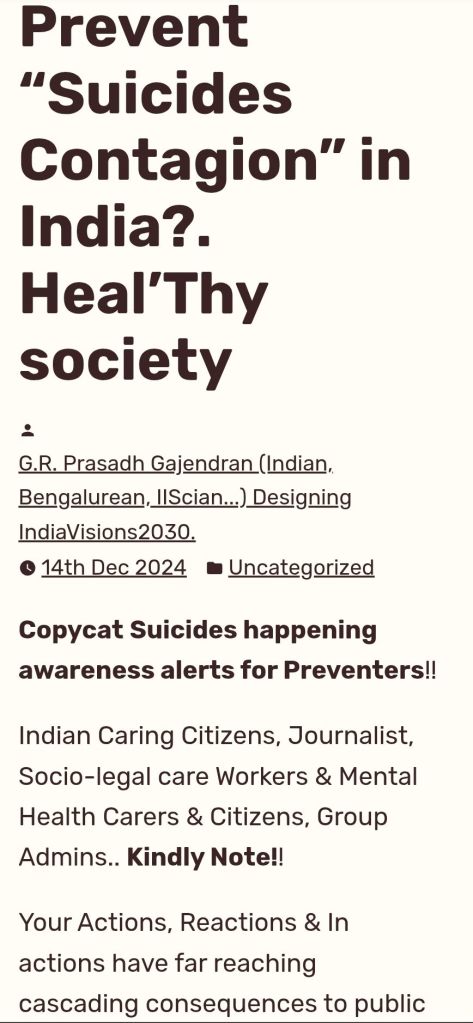
S674: How to Prevent “Suicides Contagion” in India?. Heal’Thy society
Executive Summary
The Cure’Ocity Project is a transformative initiative to address urban distress, disease, and preventable deaths in Indian cities by empowering citizens through design, science, law, policy, and self-care. By fostering participatory urban planning, leveraging scientific innovation, strengthening legal frameworks, reforming policies, and promoting self-care, the project aims to create healthier, equitable, and sustainable cities. Targeting systemic issues like poor infrastructure, weak law enforcement, and socio-economic disparities, Cure’Ocity integrates top-down reforms with grassroots empowerment to enable citizens to co-create resilient urban ecosystems. This proposal outlines the project’s objectives, strategies, implementation plan, and expected outcomes, with a focus on scalability across India.
Background
Indian cities face escalating challenges:
- Distress: Overcrowding, inadequate infrastructure, and pollution degrade quality of life (e.g., Delhi’s AQI often exceeds 300, WHO’s safe limit is 25).
- Disease: Urban health crises, including vector-borne diseases and lifestyle disorders, strain healthcare systems (e.g., 10% of urban Indians have diabetes, per ICMR 2023).
- Deaths: Preventable deaths from road accidents (1.5 lakh annually, per MoRTH 2022) and pollution-related illnesses (1.7 million annually, per Lancet 2020) are rising.
- Citizen Disempowerment: Weak enforcement, lack of civic education, and socio-economic inequities foster rule-breaking and apathy, undermining urban resilience.
The Cure’Ocity Project addresses these by empowering citizens to actively participate in healing their cities, inspired by successes like Swachh Bharat and Surat’s smart city model.
Objectives
Strategies
The Cure’Ocity Project integrates five pillars to empower citizens and heal cities:
1. Design: Citizen-Centric Urban Planning
- Participatory Design Labs: Establish community-led design labs in each city ward to co-create infrastructure solutions (e.g., pedestrian pathways, green spaces). Model: Mumbai’s 2021 “Urban Design Labs” increased citizen satisfaction by 40%.
- Smart Infrastructure: Deploy IoT-enabled systems for waste management, traffic flow, and air quality monitoring. Example: Surat’s 2022 smart waste system reduced illegal dumping by 40%.
- Accessible Public Spaces: Redesign parks, footpaths, and public transport to prioritize inclusivity for women, children, and the disabled.
2. Science: Innovation for Health and Sustainability
- Health Tech Deployment: Provide affordable wearables and apps for self-monitoring (e.g., diabetes tracking) to 1 million citizens in pilot cities within 3 years.
- Environmental Monitoring: Install low-cost air and water quality sensors, with data shared via public dashboards to spur community action. Example: Bengaluru’s 2023 citizen-led water testing reduced contamination by 15%.
- Research Partnerships: Collaborate with IITs and AIIMS to develop scalable solutions for urban health challenges (e.g., AI-based disease prediction models).
3. Law: Strengthening Enforcement and Accountability
- Tech-Driven Enforcement: Expand CCTV and AI-based monitoring for traffic, littering, and civic violations, reducing infractions by 30% (inspired by Delhi’s 2019 traffic surveillance success).
- Citizen Reporting Platforms: Launch mobile apps for anonymous reporting of violations, integrated with municipal systems for swift action.
- Legal Literacy: Conduct workshops to educate citizens on civic rights and responsibilities, targeting 50% urban youth coverage within 5 years.
4. Policy: Reforming Systems for Equity
- Incentive-Based Policies: Introduce tax breaks and rewards for compliant behaviors (e.g., waste segregation, eco-friendly commuting). Example: Chennai’s 2021 “green citizen” awards boosted compliance.
- Decentralized Governance: Empower Resident Welfare Associations (RWAs) and ward committees to oversee local projects, ensuring accountability.
- Health Equity: Subsidize healthcare access for low-income groups to reduce disease burden, modeled on Tamil Nadu’s 2022 urban health mission.
5. Self-Care: Building a Culture of Wellness
- Civic Education Campaigns: Launch multimedia campaigns (e.g., via social media, radio) to promote hygiene, mental health, and ethical behavior, reaching 70% of urban populations.
- Community Wellness Programs: Organize yoga, fitness, and nutrition workshops in public spaces, targeting 500,000 participants annually.
- Behavioral Nudges: Use signage and apps to encourage small actions (e.g., “90% of your neighbors recycle”), drawing on IIT Delhi’s 2023 nudge experiments.
Phase 1: Pilot Launch (Year 1-2)
- Cities: Select 5 diverse cities (e.g., Surat, Bhopal, Patna, Kochi, Chandigarh) for pilot implementation.
- Activities:
- Form Cure’Ocity Task Forces with municipal officials, RWAs, NGOs, and scientists.
- Set up 50 design labs and 100 wellness programs per city.
- Deploy 1,000 environmental sensors and 10,000 health tech devices.
- Launch legal literacy workshops and citizen reporting apps.
- Budget: ₹500 crore (funded via central/state grants, CSR, and PPPs).
Phase 2: Scale and Optimize (Year 3-4)
- Cities: Expand to 20 additional cities, prioritizing Tier-2 and Tier-3 urban centers.
- Activities:
- Scale design labs to 200 per city and wellness programs to 500.
- Integrate AI analytics for real-time policy adjustments.
- Evaluate pilot outcomes and refine strategies.
- Budget: ₹1,200 crore.
Phase 3: National Rollout (Year 5+)
- Cities: Cover 100+ urban centers, including metro and non-metro areas.
- Activities:
- Institutionalize Cure’Ocity as a national urban policy framework.
- Create a Cure’Ocity Citizen Network for sustained community engagement.
- Budget: ₹3,000 crore (with increased private sector involvement).
Expected Outcomes
- Distress Reduction: 30% improvement in urban livability metrics (e.g., air quality, traffic flow) in pilot cities by Year 5.
- Disease Control: 25% reduction in preventable diseases, with 1 million citizens adopting self-care tech.
- Death Prevention: 20% drop in accident- and pollution-related deaths, saving 50,000 lives annually.
- Citizen Empowerment: 50 million urban citizens engaged in design labs, wellness programs, or civic platforms.
- Cultural Shift: 40% increase in law-abiding behavior, measured via reduced civic violations and survey data.
Monitoring and Evaluation
- KPIs: Track air quality, disease incidence, mortality rates, citizen participation, and compliance levels.
- Tools: Use AI dashboards for real-time data analysis and annual third-party audits.
- Feedback Loops: Conduct quarterly citizen surveys to ensure responsiveness to community needs.
Challenges and Mitigation
- Resistance to Change: Engage local influencers and RWAs to build trust.
- Funding Constraints: Leverage PPPs and CSR funds to bridge gaps.
- Urban-Rural Divide: Tailor solutions to local contexts (e.g., smaller-scale labs in Tier-3 cities).
The Cure’Ocity Project reimagines Indian cities as spaces of health, equity, and resilience by empowering citizens to lead change. By integrating design, science, law, policy, and self-care, it addresses distress, disease, and deaths holistically. With strong stakeholder collaboration and phased implementation, Cure’Ocity can transform urban India, setting a global model for citizen-driven urban renewal. We seek approval and funding to launch pilots in 2026, paving the way for healthier, happier cities.
 GRP_VCare2Dare