“These Indians are Killing us in US and all countries…?” (Words of an American Journo in linked video about Competence of Indians)…
Ancient Harm (from 2500 BC) to Modern Form (to 2025 CE).
(Be warned this is Modern Embracing of Neo-Racisms.. Subtle Indophobhia & media Smear Campaign, Indians be on guard for Anti-India actions by Other nations, Caucasians, Chinese and Others.). Constitution can protect you but Ignorant, Arrogant and Indophobhic Nations/Nationals may harm Indian Interests.. be warned and Vigilante there have been many news cases of Racial Attacks on Indians.
Indians Brace Yourself and Familes for the coming wave of Indophobhia.
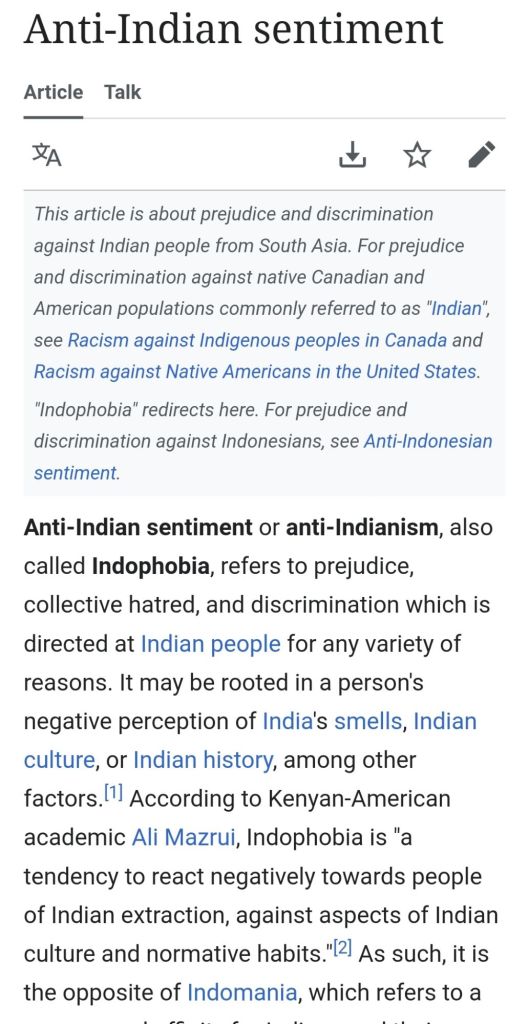
https://en.m.wikipedia.org/wiki/Anti-Indian_sentiment
IndoPhobia= (Hinduphobhia, Sikhophobia, Buddhophobhia, Athiestophobhia, Jainophobhia, Islamophobia, Secularophobhia,.. etc)
do watch this video… https://youtube.com/shorts/1vgHjMP86Vs?si=9flQlZJCAIvK51Up
#Tariffism & Racism.. https://www.business-standard.com/immigration/no-more-visas-for-indians-say-trump-supporters-america-is-full-125090401219_1.html
Question: Do Indians Dominate Positively (Fill needs) or Negatively (Kill needy) ?.
Answer: Generally Indians Dominate Positively(90%), Indians are Honest Backkers and not Immoral Backstabbers, Except a few Narc-Indians who may Dominate Negatively (Eg. Bollywood Suiciding of Sushant Singh Rajput i.e Excellence killed by Arrogance ), Backstab their own Indian Brotheren. but they are general loyalist to foreigners & foreign ideologies as they Majority Hindus believe in Vasudaiva Kutumbakam.(Whole world is a family, there are other non-ahimsic ideologies too).

This is the Side effect of Excellence in a Hyper-Supremacistic Colonial World, its less appreciation & more Envy of the Exceller. (Eg Gukesh in Chess)
Positive & Negative Dominance: there are distinct terms to differentiate these concepts:
- Positive dominance by self-excellence: This can be described as leadership, mastery, or eminence. These terms imply a form of dominance achieved through skill, competence, and positive influence, often inspiring others without diminishing them.
- Negative dominance by arrogance: This is often referred to as arrogance, hubris, or tyranny. These terms suggest a self-centered, overbearing dominance that relies on ego, intimidation, or belittling others rather than genuine merit.
The key difference lies in the intent and impact: positive dominance uplifts and is rooted in earned respect, while negative dominance alienates and stems from insecurity or entitlement.
Here’s a concise breakdown of the differences between Dominance, Excellence, Prominence, and Predominance, focusing on their meanings and nuances, especially in the context of your earlier question about positive and negative forms of dominance:
- Dominance: Refers to the state of having control, authority, or superior influence over others. It emphasizes power or supremacy, often in a competitive or hierarchical sense. Dominance can be positive (e.g., a team dominating through skill) or negative (e.g., domineering behavior rooted in arrogance). Context determines its tone.
- Example: A company’s dominance in the market due to innovation (positive) vs. a bully’s dominance through intimidation (negative).
- Excellence: Denotes outstanding quality, skill, or achievement in a specific area, without necessarily implying control over others. It’s about surpassing standards and is inherently positive, focusing on self-improvement and mastery rather than comparison or supremacy.
- Example: An artist achieving excellence in their craft, earning admiration without seeking to dominate.
- Prominence: Indicates being widely recognized, noticeable, or distinguished, often due to achievements or visibility. It’s about standing out in a field or society, not necessarily exerting control. Prominence is typically positive or neutral, tied to reputation rather than power.
- Example: A scientist gaining prominence for groundbreaking research, respected but not necessarily dominant.
- Predominance: Refers to having greater influence, prevalence, or frequency within a specific context, often implying a relative superiority over alternatives. It’s less about absolute control (like dominance) and more about being the most common or influential element. It can be neutral or positive, depending on context.
- Example: The predominance of renewable energy in a country’s grid, indicating its primary role without implying oppression.
Key Differences:
- Intent and Scope: Dominance often involves control or power over others, while excellence is about personal or intrinsic quality. Prominence focuses on visibility and recognition, and predominance highlights prevalence or influence in a specific domain.
- Tone: Excellence is inherently positive, dominance can be positive or negative, prominence is usually positive or neutral, and predominance is context-dependent but often neutral.
- Relation to Others: Dominance may suppress or outrank others, prominence elevates one’s status without necessarily diminishing others, excellence is self-focused, and predominance suggests being the leading element among many.
In Context of Your Earlier Question:
- Positive dominance by self-excellence aligns with excellence (mastery through skill) or prominence (recognition for merit). It could also be a form of dominance when achieved through inspiring leadership.
- Negative dominance by arrogance is best described as dominance with a negative connotation, where the focus is on ego-driven control rather than merit. Predominance wouldn’t typically apply here unless arrogance is the most common trait in a specific context.
If you’d like further clarification or examples, let me know!
Indophobia, or anti-Indian sentiment, manifests as prejudice, discrimination, or hostility toward Indian people, culture, or the nation of India. Below is a summary of reported incidents and trends since 2020, based on available information and analysis, addressing both overt and subtle forms of Indophobia globally. The search results provided limited direct references to Indophobia, so I’ve supplemented with broader context and critical analysis where relevant.
1. North America
- United States (2025): An Indian student sued the Trump administration after their visa was revoked, part of a broader crackdown on international students accused of campus activism. This policy disproportionately affected Indian students, who form a significant portion of international students in the U.S. The revocation was perceived by some as discriminatory, fueling discussions about xenophobia targeting Indian students.
- Context: Indian students have faced scrutiny in the U.S. amid rising geopolitical tensions and immigration debates. Policies targeting specific groups, like those from South Asia, can amplify Indophobic sentiments, though not always explicitly labeled as such.
- General Trends: Reports of hate crimes against Indian Americans have risen since 2020, often linked to broader anti-Asian sentiment during the COVID-19 pandemic. For example, Indian Americans reported verbal harassment and physical assaults in cities like New York and California, with perpetrators sometimes conflating Indian identity with other Asian ethnicities. Specific data on Indophobia is sparse, as it’s often categorized under anti-Asian hate.
- Canada: While no specific incidents of Indophobia were detailed in the provided search results, Canada’s large Indian diaspora has faced occasional backlash amid immigration debates. For instance, in 2023, social media platforms saw anti-Indian rhetoric targeting Sikh Canadians, often tied to India-Canada diplomatic tensions over the Khalistan movement. This wasn’t explicitly reported as Indophobia but reflects underlying prejudice against Indian-origin communities.
2. South Asia
- Bangladesh (2025): U.S. Director of National Intelligence Tulsi Gabbard highlighted the persecution and killing of Hindus in Bangladesh as a concern for the Trump administration. This statement, made during a visit to India, underscores ongoing violence against Hindu minorities, many of whom are ethnically Indian or tied to Indian culture. Such persecution can be interpreted as a form of Indophobia, as it targets communities associated with India.
- Context: Since 2020, Bangladesh has seen periodic attacks on Hindu temples and communities, often linked to political instability or religious extremism. These acts are driven by local dynamics but can reflect broader anti-Indian sentiment, given India’s cultural and historical influence.
- Pakistan (2025): India’s government reported to its Parliament that Hindus and other minorities face violence and discrimination in Pakistan, including forced conversions and marriages. While this is primarily religious persecution, it intersects with Indophobia due to the targeting of communities culturally linked to India.
- Context: Anti-Indian sentiment in Pakistan is often tied to geopolitical rivalries, with Indian culture or Hindu identity sometimes vilified in media or public discourse.
3. Europe
- United Kingdom: Since 2020, the UK has reported instances of Indophobia, particularly during periods of heightened India-UK tensions or domestic political debates. For example:
- In 2022, Leicester saw riots involving clashes between Hindu and Muslim communities, with some reports indicating anti-Indian rhetoric targeting Hindu Indians. These incidents were fueled by misinformation and social media, amplifying prejudice against Indian cultural practices.
- Anti-Indian sentiment has also surfaced in discussions about immigration, with far-right groups occasionally targeting Indian professionals or students as “outsiders.” This is often subtle, embedded in broader anti-immigrant narratives.
- Other European Countries: Limited specific reports exist, but Indian diaspora communities in Germany and France have noted occasional microaggressions, such as stereotyping Indians as “overly academic” or “job competitors.” These sentiments, while not always violent, contribute to a low-level Indophobic climate.
4. Global Economic and Political Context
- Trade and Geopolitical Tensions (2025): Recent U.S. tariffs and trade policies under the Trump administration have spotlighted India, with reports criticizing policies like “Make in India” as trade barriers. While economic critiques are not inherently Indophobic, the framing of India as an economic threat can fuel negative stereotypes about Indian businesses or workers.
- Example: Articles discussing Trump’s tariffs often portray India as a potential beneficiary of U.S.-China trade wars but question its readiness, sometimes with a condescending tone about its infrastructure or workforce.
- Media Stereotyping: Globally, Indian culture is sometimes caricatured in media, perpetuating stereotypes (e.g., overpopulation, poverty, or “exotic” traditions). Since 2020, Bollywood’s global rise has countered some stereotypes, but negative portrayals persist, subtly reinforcing Indophobia.
5. Online and Social Media Trends
- X Platform: No specific trends from X directly addressed Indophobia, but broader discussions about global trade, immigration, and cultural identity often include anti-Indian sentiment. For example, posts about Indian professionals in tech or immigration to Western countries sometimes attract derogatory comments, reflecting Indophobic attitudes. These are inconclusive without specific data but align with anecdotal reports.
- Misinformation: Since 2020, social media has amplified Indophobia through fake news or divisive narratives, such as false claims about Indian migrants or cultural practices. This is particularly evident in diaspora-heavy regions like the U.S., UK, and Australia.
Critical Analysis
- Underreporting: Indophobia is often underreported or subsumed under broader categories like anti-Asian or anti-immigrant sentiment. This makes it challenging to isolate specific incidents, especially in Western countries where data collection doesn’t always differentiate Indian identity.
- Geopolitical Influence: Anti-Indian sentiment is frequently tied to India’s growing global influence, whether economic (e.g., tech industry dominance) or political (e.g., India’s neutral stance in global conflicts). This can manifest as envy or suspicion, subtly fueling Indophobia.
- Intersectionality: Indophobia often intersects with religious (anti-Hindu), racial, or class-based prejudice. For instance, attacks on Indian minorities in South Asia are primarily religious but carry Indophobic undertones due to India’s association with Hinduism.
Limitations
The provided search results offered limited direct evidence of Indophobia, focusing more on trade, geopolitics, and minority persecution. Broader trends were inferred from news reports and contextual knowledge. Specific incidents of Indophobia, especially in diaspora communities, are often anecdotal or under-documented in mainstream media. For deeper insights, targeted research into diaspora experiences or social media analysis would be needed.
Conclusion
Since 2020, Indophobia has surfaced globally in various forms: hate crimes in the U.S., minority persecution in South Asia, subtle prejudice in Europe, and economic stereotyping in trade discussions. While overt incidents are less frequently reported, subtle biases in media, policy, and public discourse contribute to a persistent undercurrent of anti-Indian sentiment. For further details on specific incidents, sources like Hindustan Times or The Hindu provide ongoing coverage of India-related issues.
If you’d like me to focus on a specific region or type of Indophobia (e.g., online, diaspora-specific), let me know!

 GRP_VCare2Dare