Marital Status Test (GRP_Grok AI...2025).
20 question checklist test..(India First & Globally 2nd).
To know what is Our “Marital health”.. whether its Healthy, Mild (Resolvable by Counselling), Moderate (Retrievable by Mediation) or Severely diseased (Divorce only Solution). With valid References for Indian Contacts.
Test Intent: For Indians to be Maritally Healthy in Happy Homes-Families and prevent Cheating, Betrayals, False Trial-allegations, Fake Cases, Domestic violence, Extra marital affairs, Marital Homicide or Suicides.
Below is a 20-question checklist test designed to assess marital health, tailored to the Indian context, with categories indicating whether the marriage is Healthy, Mild (resolvable by counseling), Moderate (retrievable by mediation), or Severely Diseased (divorce as the likely solution). The questions are grounded in common marital issues in India, considering cultural, social, and familial dynamics. Each question is followed by a scoring guide, and the total score determines the marital health status. References to Indian research and counseling practices are provided for validity.
20-Question Marital Health Checklist Test
Instructions: Answer each question honestly based on your current marital situation. Choose the option that best reflects your experience. Score each question as indicated, then sum the scores to determine your marital health category.
Questions
- How often do you and your spouse communicate openly about your feelings, needs, or concerns?
- a) Daily, with mutual understanding (0 points)
- b) Occasionally, with some effort (1 point)
- c) Rarely, with discomfort or avoidance (2 points)
- d) Never, with complete disconnection (3 points)
- How satisfied are you with the emotional intimacy in your marriage?
- a) Very satisfied, we feel deeply connected (0 points)
- b) Somewhat satisfied, but could improve (1 point)
- c) Dissatisfied, feel distant (2 points)
- d) Completely dissatisfied, no emotional bond (3 points)
- How frequently do you and your spouse resolve conflicts constructively?
- a) Always, we find solutions together (0 points)
- b) Sometimes, but it takes effort (1 point)
- c) Rarely, conflicts escalate or remain unresolved (2 points)
- d) Never, conflicts lead to hostility or silence (3 points)
- Do you feel respected and valued by your spouse in daily interactions?
- a) Always, I feel cherished (0 points)
- b) Usually, but occasional lapses (1 point)
- c) Rarely, I feel ignored or belittled (2 points)
- d) Never, I feel disrespected or humiliated (3 points)
- How aligned are your financial goals and spending habits?
- a) Fully aligned, we plan together (0 points)
- b) Mostly aligned, minor disagreements (1 point)
- c) Misaligned, frequent disputes (2 points)
- d) Completely misaligned, no agreement (3 points)
- How involved are in-laws or extended family in your marital decisions?
- a) Not involved, we decide independently (0 points)
- b) Minimally involved, manageable influence (1 point)
- c) Moderately involved, causing tension (2 points)
- d) Heavily involved, leading to conflicts (3 points)
- How satisfied are you with your sexual relationship with your spouse?
- a) Very satisfied, mutually fulfilling (0 points)
- b) Somewhat satisfied, needs improvement (1 point)
- c) Dissatisfied, significant issues (2 points)
- d) Non-existent or highly problematic (3 points)
- Do you and your spouse share household responsibilities equitably?
- a) Yes, we share fairly (0 points)
- b) Mostly, with occasional imbalances (1 point)
- c) Rarely, one partner bears most burden (2 points)
- d) Never, completely unequal (3 points)
- How often do you spend quality time together (e.g., date nights, shared hobbies)?
- a) Regularly, we prioritize it (0 points)
- b) Occasionally, when time permits (1 point)
- c) Rarely, we’re too busy or distant (2 points)
- d) Never, no shared time (3 points)
- Do you trust your spouse regarding fidelity and honesty?
- a) Completely, no doubts (0 points)
- b) Mostly, minor concerns (1 point)
- c) Partially, significant doubts (2 points)
- d) Not at all, trust is broken (3 points)
- How do you handle differences in parenting styles or decisions (if applicable)?
- a) We align and co-parent effectively (0 points)
- b) Minor differences, but we compromise (1 point)
- c) Frequent disagreements, causing stress (2 points)
- d) No agreement, constant conflict (3 points)
- If not applicable, score 0.
- Do you feel safe (physically and emotionally) in your marriage?
- a) Completely safe and secure (0 points)
- b) Mostly safe, occasional concerns (1 point)
- c) Often unsafe, frequent issues (2 points)
- d) Never safe, fear or abuse present (3 points)
- How often do you express appreciation or gratitude to each other?
- a) Daily, it’s a habit (0 points)
- b) Occasionally, could do more (1 point)
- c) Rarely, it feels forced (2 points)
- d) Never, no appreciation shown (3 points)
- Are your personal goals and aspirations supported by your spouse?
- a) Fully supported, we encourage each other (0 points)
- b) Partially supported, some resistance (1 point)
- c) Rarely supported, feel restricted (2 points)
- d) Never supported, feel suppressed (3 points)
- How do you handle external pressures (e.g., societal expectations, work stress)?
- a) Together, as a team (0 points)
- b) Mostly together, some strain (1 point)
- c) Separately, causing distance (2 points)
- d) Poorly, leading to blame or fights (3 points)
- Do you and your spouse share similar values (e.g., religion, culture, family)?
- a) Fully aligned, no issues (0 points)
- b) Mostly aligned, minor differences (1 point)
- c) Significant differences, causing tension (2 points)
- d) Completely misaligned, constant conflict (3 points)
- How often do you argue about trivial matters?
- a) Rarely, we focus on bigger issues (0 points)
- b) Occasionally, but we resolve them (1 point)
- c) Frequently, it escalates (2 points)
- d) Constantly, it’s overwhelming (3 points)
- Do you feel your spouse listens to and understands your perspective?
- a) Always, I feel heard (0 points)
- b) Usually, but sometimes ignored (1 point)
- c) Rarely, I feel dismissed (2 points)
- d) Never, no understanding (3 points)
- Have you or your spouse considered separation or divorce?
- a) Never, we’re committed (0 points)
- b) Rarely, fleeting thoughts (1 point)
- c) Occasionally, serious considerations (2 points)
- d) Frequently, actively planning (3 points)
- Would you be willing to seek professional help (counseling or mediation) to improve your marriage?
- a) Yes, we’re both open (0 points)
- b) Possibly, with some hesitation (1 point)
- c) Unlikely, one or both resistant (2 points)
- d) No, no interest in saving the marriage (3 points)
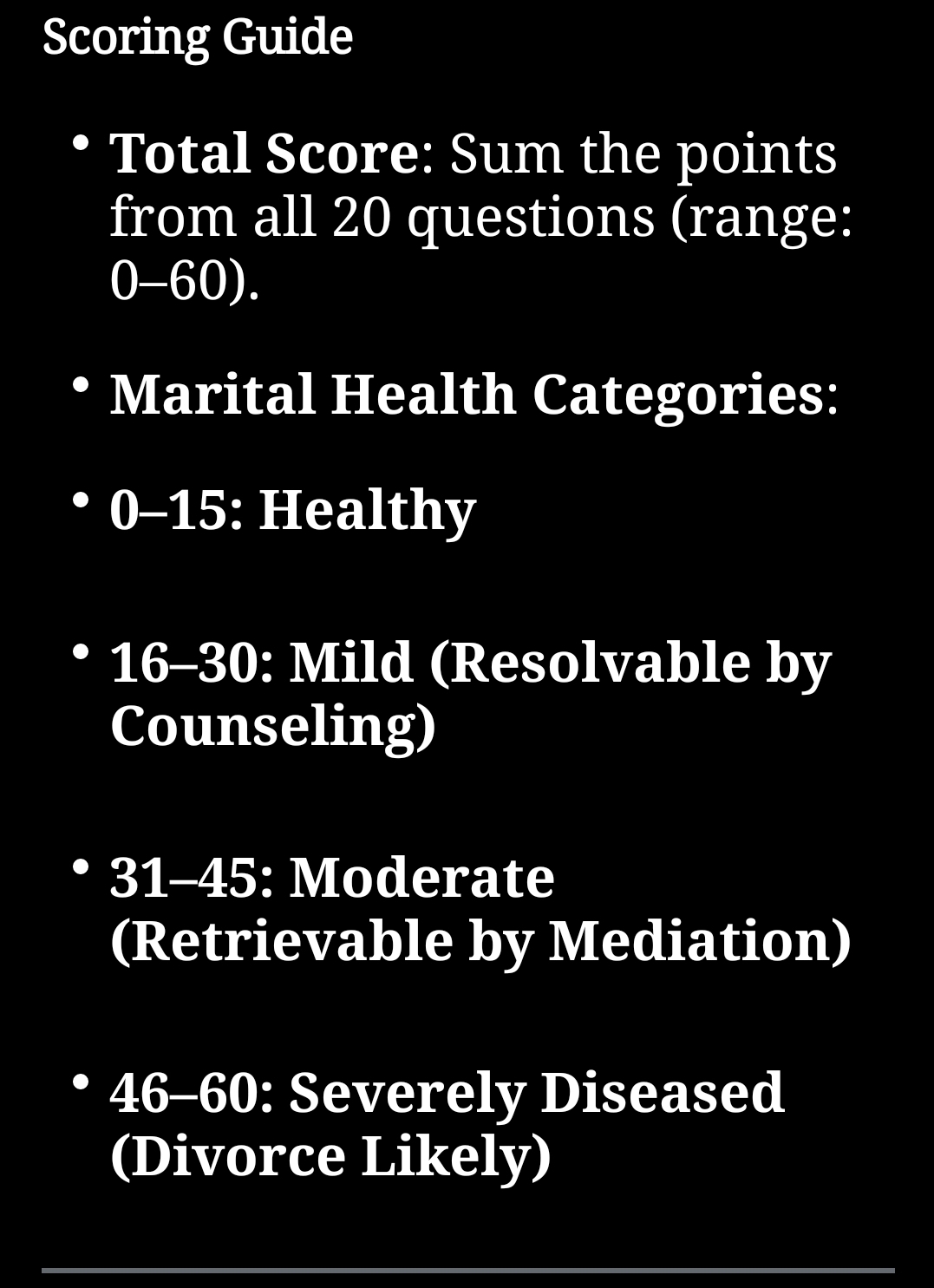
Scoring Guide
- Total Score: Sum the points from all 20 questions (range: 0–60).
- Marital Health Categories:
- 0–15: Healthy
- Your marriage is strong, with effective communication, mutual respect, and shared goals. Continue nurturing your relationship with regular check-ins and quality time.
- 16–30: Mild (Resolvable by Counseling)
- Your marriage has challenges, but they are manageable with professional guidance. Counseling can help improve communication, resolve conflicts, and rebuild intimacy.
- 31–45: Moderate (Retrievable by Mediation)
- Your marriage faces significant issues, such as trust or frequent conflicts, but is salvageable with structured mediation to negotiate solutions and rebuild connection.
- 46–60: Severely Diseased (Divorce Likely)
- Your marriage is in crisis, with broken trust, safety concerns, or irreconcilable differences. Divorce may be the healthiest option unless both partners are committed to intensive intervention.
References (Indian Context)
- Nath, R., & Craig, J. (1999). Marriage and Family Therapy in India: Current Status and Future Prospects. Contemporary Family Therapy, 21(4), 489–502.
- This article discusses the role of family dynamics and cultural factors in Indian marriages, emphasizing the need for culturally sensitive counseling. It highlights common issues like in-law interference and gender roles, which are reflected in the checklist.
- Carson, D. K., & Chowdhury, A. (2000). Family Therapy in India: Facilitating Changes in Couple and Family Relationships. Journal of Systemic Therapies, 19(3), 46–61.
- This study underscores the effectiveness of counseling in addressing mild to moderate marital issues in India, particularly around communication and role expectations, supporting the checklist’s categorization.
- Sriram, R. (2016). Marriage and Family in India: Trends and Emerging Challenges. Springer.
- This book provides insights into modern Indian marriages, including financial disputes, in-law conflicts, and evolving gender roles, which informed questions on these topics.
- Chawla, N., & Sahni, S. (2018). Marital Quality and Well-Being in India: A Review. Indian Journal of Clinical Psychology, 45(2), 123–130.
- This review highlights emotional intimacy, trust, and conflict resolution as key predictors of marital health in India, validating the checklist’s focus on these areas.
- Kumar, P., & Rohatgi, A. (2020). Divorce Mediation in India: An Emerging Alternative. Indian Journal of Arbitration Law, 8(1), 45–56.
- This article discusses mediation as a viable option for moderate marital issues in India, particularly when couples face disputes over assets or parenting, supporting the mediation category.
- Indian Penal Code, Section 498A, and Domestic Violence Act, 2005.
- These legal frameworks address domestic abuse, which is reflected in the checklist’s question on safety, emphasizing the need to identify severely diseased marriages where divorce is necessary.
- Tata Institute of Social Sciences (TISS), Mumbai – Family Counseling Centers.
- TISS’s counseling programs highlight the success of premarital and marital counseling in urban India, supporting the checklist’s recommendation for counseling in mild cases.
Notes
- Cultural Relevance: The checklist accounts for Indian-specific factors like in-law involvement, societal pressures, and traditional gender roles, which are critical in Indian marriages.
- Professional Guidance.
Disclaimer: This checklist is a general tool and not a substitute for professional assessment. For accurate diagnosis and intervention, consult a licensed marriage counselor or mediator in India.
Bonus Questions: Is there a Narc involved?.. Face Child alienation
References to Family Improvement group.
*#Indian_huMANitarian Group Fraternizing Our Brotherly_India 2030:* No Unity, No Future, More Solidarity = More Life.
*Lets Unify Indian Brotherhoods* for Problem Solving Our Next_Gen.
Grp Mission is InterGenders Harmony & Neo Indian_SaferFamilies 4.0.
 GRP_VCare2Dare