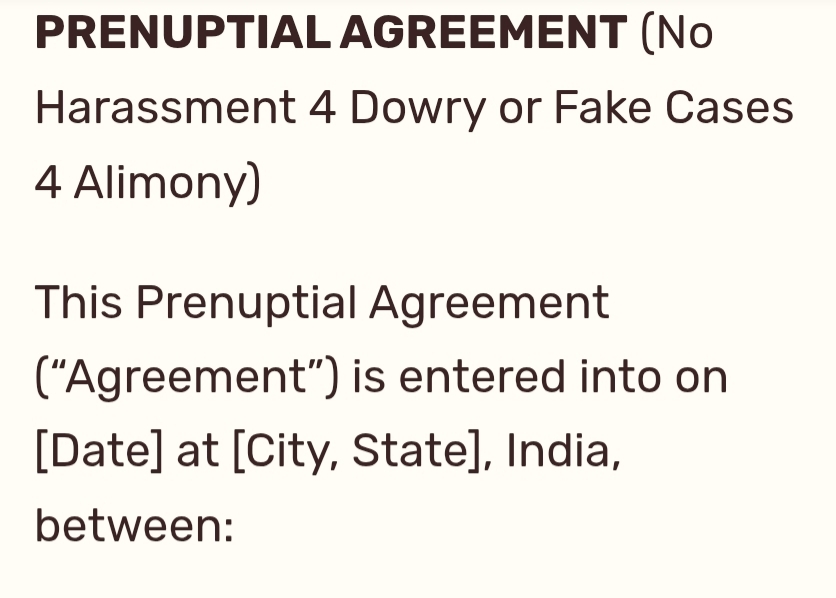
Free Editable Legal template for an “Indian Prenuptial Agreement” tailored to facilitate a zero-dowry and zero-alimony arrangement under Indian law.
Please note that this is a general template and must be reviewed and customized by a qualified legal professional to ensure compliance with applicable laws, including the Indian Contract Act, 1872, and relevant personal laws (Hindu Marriage Act, 1955, Indian Christian Marriage Act, 1872, Muslim Personal Law, etc.).
Prenuptial agreements in India are not explicitly recognized under statute but can be enforceable if they meet the requirements of a valid contract (free consent, lawful object, etc.) and are fair and reasonable.
P A R T – 1
PRENUPTIAL AGREEMENT 2025 4Indians (NO Harassment 4 Dowry (Narc-Groomside) & NO Harassment by Fake Cases 4 Alimoney & Progeny (Narc-Brideside).
This 0Dowry & 0Alimony Prenuptial Agreement (“Agreement”) is entered into on [Date] at [City, State], India, between:
1. [Full Name of Party 1], aged [Age], residing at [Address], hereinafter referred to as the “First Party”; and
2. [Full Name of Party 2], aged [Age], residing at [Address], hereinafter referred to as the “Second Party”.
WHEREAS:
A. The First Party and Second Party (collectively referred to as the “Parties”) intend to marry each other on [Date of Marriage] under the provisions of [Applicable Law, e.g., Hindu Marriage Act, 1955/Special Marriage Act, 1954, etc.].
B. The Parties wish to define their financial rights and obligations during and after the marriage, including provisions to eliminate dowry and alimony/maintenance claims.
C. The Parties have fully disclosed their financial positions to each other and enter this Agreement voluntarily, with free consent, and without any coercion, undue influence, or misrepresentation.
D. The Parties intend for this Agreement to be legally binding, subject to the laws of India, and enforceable to the extent permitted by law.
NOW, THEREFORE, the Parties agree as follows:
1. Definitions
1.1. Dowry: Any property, money, or valuable security given or agreed to be given, directly or indirectly, by one party to the marriage or their family to the other party or their family, as a condition of marriage, as defined under Section 2 of the Dowry Prohibition Act, 1961.
1.2. Alimony/Maintenance: Any financial support or payment, whether periodic or lump-sum, claimed by one spouse from the other during or after the dissolution of marriage, including under Section 125 of the Code of Criminal Procedure, 1973, Section 24 of the Hindu Marriage Act, 1955, or any other applicable law.
1.3. Separate Property: Assets and liabilities owned by either Party before marriage, as listed in Schedule A (First Party) and Schedule B (Second Party), and any assets acquired individually during marriage through inheritance, gift, or personal earnings, unless explicitly agreed otherwise.
1.4. Joint Property: Assets acquired jointly by the Parties during the marriage with mutual contributions and intent to co-own.
2. No Dowry
2.1. Both Parties unequivocally agree that no dowry, as defined under the Dowry Prohibition Act, 1961, has been or will be demanded, given, or accepted, directly or indirectly, by either Party or their families in connection with the marriage.
2.2. Any demand for dowry by either Party or their representatives shall constitute a material breach of this Agreement and render the offending party liable for legal consequences under the Dowry Prohibition Act, 1961.
2.3. The Parties affirm that the marriage is based on mutual consent and affection, free from any financial inducements or conditions.
3. No Alimony or Maintenance
3.1. In the event of separation, divorce, or dissolution of marriage, both Parties irrevocably waive any right to claim alimony, maintenance, or financial support from the other, whether under Section 125 of the Code of Criminal Procedure, 1973, Section 24 or 25 of the Hindu Marriage Act, 1955, or any other applicable law.
3.2. This waiver applies to both interim and permanent maintenance, lump-sum payments, or any other form of financial support, except as required for the maintenance of any children born of the marriage, which shall be decided separately as per applicable law.
3.3. The Parties acknowledge that this waiver is made with full understanding of their financial positions and future earning capacities, as disclosed in Schedule C (Financial Disclosures).
4. Property Rights
4.1. Separate Property: Each Party shall retain sole ownership and control of their Separate Property, as listed in Schedule A and Schedule B, including any income, appreciation, or proceeds derived therefrom, free from any claim by the other Party during or after the marriage.
4.2. Joint Property: Any property acquired jointly during the marriage shall be divided equally or as mutually agreed in writing in the event of separation or divorce, subject to applicable laws.
4.3. Debts: Each Party shall be solely responsible for their pre-marital debts and any debts incurred individually during the marriage, unless explicitly agreed otherwise in writing.
5. Financial Disclosures
5.1. Both Parties have fully and truthfully disclosed their assets, liabilities, income, and financial obligations to each other, as detailed in Schedule C attached hereto.
5.2. Any failure to disclose material financial information shall render this Agreement voidable at the option of the non-defaulting Party.
6. Voluntary Execution
6.1. The Parties confirm that they have entered into this Agreement voluntarily, with free consent, and after due consideration of its implications.
6.2. Each Party has had the opportunity to seek independent legal advice before signing this Agreement and acknowledges understanding its terms fully.
7. Governing Law and Jurisdiction
7.1. This Agreement shall be governed by and construed in accordance with the laws of India, including the Indian Contract Act, 1872, and applicable personal laws.
7.2. Any disputes arising out of or in connection with this Agreement shall be subject to the exclusive jurisdiction of the courts at [City, State].
8. Severability
8.1. If any provision of this Agreement is found to be invalid, illegal, or unenforceable by a court of competent jurisdiction, the remaining provisions shall continue to be valid and enforceable to the fullest extent permitted by law.
9. Amendments
9.1. This Agreement may only be amended or modified by a written document signed by both Parties and notarized.
10. Entire Agreement
10.1. This Agreement constitutes the entire understanding between the Parties and supersedes all prior discussions, agreements, or understandings, whether oral or written, relating to the subject matter herein.
IN WITNESS WHEREOF, the Parties have executed this Prenuptial Agreement on the date and place first above written.
First Party
Name: [Full Name]
Signature: _______________
Date: [Date]
Second Party
Name: [Full Name]
Signature: _______________
Date: [Date]
Witnesses
- Name: [Full Name]
Address: [Address]
Signature: _______________
Date: [Date] - Name: [Full Name]
Address: [Address]
Signature: _______________
Date: [Date]
Notary Public
This Agreement was acknowledged before me on [Date] by [Name of First Party] and [Name of Second Party].
Notary’s Signature: _______________
Seal:
Commission Expires: [Date]
Schedule A: Separate Property of First Party
[List all assets, e.g., immovable property, bank accounts, jewelry, investments, etc., with approximate values]
Schedule B: Separate Property of Second Party
[List all assets, e.g., immovable property, bank accounts, jewelry, investments, etc., with approximate values]
Schedule C: Financial Disclosures
- First Party: [Details of income, assets, liabilities, etc.]
- Second Party: [Details of income, assets, liabilities, etc.]
Important Notes:
- Legal Consultation: This template must be reviewed by a lawyer familiar with Indian family law to ensure enforceability, as courts in India may scrutinize prenuptial agreements for fairness and compliance with public policy.
- Notarization: The Agreement should be notarized to enhance its evidentiary value.
- Child Maintenance: Indian courts may override waivers of maintenance for children, as child welfare is a priority under law.
- Cultural Sensitivity: Ensure both families are informed and consent to avoid disputes, as dowry-related issues are sensitive in India.
- Registration: While not mandatory, registering the Agreement with a sub-registrar may add legal weight.
If you need assistance finding a lawyer or tailoring this further, let me know!
Disclaimer: Grok is not a lawyer; please consult one. Don’t share information that can identify you.
P A R T -2
If Marriage has Children planned then Read & Include Below clauses.
Joint Parenting and Child Custody Clauses for Prenuptial Agreement
The following clauses outline the intentions of [Party A Name] and [Party B Name] regarding joint or shared parenting and fair child custody arrangements in the event of a separation or divorce. These clauses are intended to prioritize the best interests of any children born of or adopted during the marriage and to promote a cooperative co-parenting relationship.
Clause 1: Commitment to Joint Parenting
- Shared Responsibility: Both parties agree to share parenting responsibilities for any children born of or adopted during the marriage, prioritizing the children’s emotional, physical, and developmental well-being.
- Cooperative Decision-Making: Major decisions regarding the children’s education, healthcare, religious upbringing, and extracurricular activities shall be made jointly by both parties, with both parents engaging in good-faith discussions to reach mutual agreement.
- Best Interests of the Child: All parenting decisions shall be guided by the best interests of the child, as determined by both parties in consultation with relevant professionals (e.g., pediatricians, educators, or counselors) when necessary.
Clause 2: Shared Custody Arrangement
- Equal Physical Custody: In the event of separation or divorce, both parties agree to pursue a shared physical custody arrangement, aiming for an equitable division of time with the children, such as a 50/50 schedule, unless otherwise determined to be impractical or not in the children’s best interests.
- Residence Proximity: Both parties agree to make reasonable efforts to reside within a mutually agreed geographic area to facilitate shared custody and minimize disruption to the children’s routines, such as school and social activities.
- Flexible Scheduling: The parties shall work together to create a parenting schedule that accommodates the children’s needs and each parent’s availability, with flexibility to adjust for special circumstances (e.g., holidays, school events, or family gatherings).
- Legal Custody: Both parties shall share joint legal custody, granting each parent equal rights and responsibilities in making decisions about the children’s welfare.
Clause 3: Dispute Resolution
- Mediation: In the event of disagreements regarding parenting or custody matters, both parties agree to first pursue mediation with a neutral, qualified mediator before resorting to litigation, to resolve disputes amicably and in the children’s best interests.
- Consultation with Professionals: If mediation does not resolve the issue, the parties may consult child psychologists, family counselors, or other relevant professionals to provide recommendations aligned with the children’s well-being.
- Court as Last Resort: Litigation shall be considered only as a last resort, and both parties agree to prioritize out-of-court resolutions to minimize stress on the children.
Clause 4: Financial Support for Children
- Shared Financial Responsibility: Both parties agree to contribute equitably to the financial support of the children, including expenses for education, healthcare, childcare, and extracurricular activities, in proportion to their respective incomes or as otherwise agreed.
- Transparency: Both parties shall maintain transparency regarding their financial contributions to the children’s needs and shall provide documentation of expenses upon reasonable request.
- Review of Support: Financial arrangements shall be reviewed periodically (e.g., annually or upon significant changes in income) to ensure fairness and adequacy in meeting the children’s needs.
Clause 5: Communication and Co-Parenting Guidelines
- Open Communication: Both parties agree to maintain respectful, open, and direct communication regarding the children’s needs, schedules, and well-being, using mutually agreed-upon methods (e.g., email, co-parenting apps, or phone calls).
- Non-Disparagement: Neither party shall speak negatively about the other parent in the presence of the children or engage in behavior that undermines the children’s relationship with the other parent.
- Consistency in Parenting: Both parties shall strive to maintain consistent rules, routines, and expectations across households to provide stability for the children.
Clause 6: Modification of Agreement
- Mutual Consent: Any modifications to this parenting and custody agreement shall be made in writing and signed by both parties, reflecting changes in circumstances or the children’s needs.
- Court Approval: If required by law, modifications shall be submitted to a court of competent jurisdiction for approval to ensure compliance with applicable legal standards.
- Children’s Input: As children reach an appropriate age (as determined by state law or mutual agreement), their preferences may be considered in modifying custody or parenting arrangements, provided it aligns with their best interests.
Clause 7: Contingency for Relocation
- Notice of Relocation: If either party intends to relocate to a location that may impact the shared custody arrangement, they shall provide the other party with at least ninety (90) days’ written notice, including details of the proposed move and its potential impact on the children.
- Negotiation of Adjustments: Both parties shall negotiate in good faith to adjust the custody schedule or arrangements to maintain meaningful parental involvement, potentially including extended visitation periods or virtual contact.
- Mediation for Disputes: If agreement cannot be reached on relocation terms, the parties shall engage in mediation to resolve the matter before seeking court intervention.
Note: These clauses are intended as a framework for inclusion in a prenuptial agreement and should be reviewed and customized by a qualified family law attorney to ensure compliance with applicable state laws and the specific circumstances of the parties. The enforceability of custody provisions in a prenuptial agreement may vary by jurisdiction, as courts typically prioritize the best interests of the child at the time of separation or divorce.
P A R T – 3
Covers Sharing of Responsibility, Property & Progeny.
Clauses for Indian Prenuptial Agreement
The following clauses outline the intentions of [Party A Name] and [Party B Name] regarding the matrimonial home, care for in-laws, engagement of marital counsellors, child alienation counsellors, and divorce lawyers, in the event of disputes or dissolution of marriage. These clauses are drafted with consideration of Indian legal and cultural contexts, prioritizing mutual respect and the well-being of the family. Note that enforceability of prenuptial agreements in India may vary based on judicial interpretation and compliance with laws such as the Indian Contract Act, 1872, and relevant personal laws.
Clause 1: Matrimonial Home
- Ownership and Residency:
- The matrimonial home, whether purchased jointly or individually during the marriage, shall be considered a shared residence for both parties and any children born of or adopted during the marriage, unless otherwise agreed.
- In the event of separation or divorce, both parties agree to negotiate in good faith regarding the continued use or disposal of the matrimonial home, prioritizing the best interests of any minor children.
- Financial Contributions:
- Both parties shall transparently document their financial contributions toward the purchase, maintenance, or improvement of the matrimonial home, including mortgage payments, taxes, and utilities.
- In case of dissolution of marriage, contributions to the matrimonial home shall be considered for equitable division, subject to applicable laws (e.g., Hindu Marriage Act, 1955, or other personal laws).
- Temporary Occupancy:
- If separation occurs, the party with primary custody of minor children (if any) shall have the right to reside in the matrimonial home until the children reach the age of majority or as mutually agreed, provided it is financially feasible.
- The non-residing party shall not unreasonably interfere with the use of the matrimonial home by the residing party during this period.
- Disposal of Property:
- Any decision to sell or transfer the matrimonial home shall require mutual consent, and proceeds shall be divided equitably after accounting for contributions and legal entitlements under applicable laws.
Clause 2: Care for In-Laws
- Mutual Respect and Support:
- Both parties agree to treat each other’s parents (in-laws) with respect and dignity, fostering a harmonious family environment.
- Emotional and social support for in-laws shall be provided as mutually agreed, recognizing cultural expectations under Indian family norms.
- Financial Assistance:
- If either party chooses to provide financial support to their parents, such contributions shall be discussed transparently to ensure alignment with joint financial goals.
- In the event of separation or divorce, neither party shall be obligated to provide financial support to the other’s parents, unless voluntarily agreed or mandated by law (e.g., Maintenance and Welfare of Parents and Senior Citizens Act, 2007).
- Living Arrangements:
- If in-laws reside with the couple, both parties shall mutually agree on living arrangements, including responsibilities for their care, household contributions, and duration of stay.
- In case of separation, the party biologically or legally related to the in-laws shall assume primary responsibility for their care, unless otherwise agreed.
- Dispute Resolution:
- Any disputes regarding in-laws’ care or involvement in family matters shall be addressed through open communication or mediation to maintain family harmony and avoid escalation.
Clause 3: Engagement of Marital Counsellors
- Commitment to Counselling:
- In the event of marital discord, both parties agree to engage a qualified marital counsellor to address issues and explore reconciliation before pursuing separation or divorce.
- Counselling shall be undertaken in good faith, with both parties committing to attend a minimum of [e.g., 6] sessions unless mutually agreed otherwise.
- Selection of Counsellor:
- The marital counsellor shall be mutually selected from a list of licensed professionals with expertise in family and marital therapy, preferably registered with a recognized body such as the Indian Association of Clinical Psychologists.
- If agreement cannot be reached, each party may nominate one counsellor, and a third neutral counsellor shall be appointed by mutual consent or mediation.
- Confidentiality:
- All discussions during counselling shall remain confidential, except as required by law (e.g., in cases involving abuse or harm).
- Neither party shall use counselling discussions as evidence in legal proceedings, except with mutual consent or court approval.
- Costs:
- The costs of marital counselling shall be shared equitably between the parties, unless otherwise agreed or determined by financial circumstances.
Clause 4: Engagement of Child Alienation Counsellors
- Prevention of Parental Alienation:
- Both parties agree to foster a positive relationship between the children and the other parent, refraining from actions or statements that may alienate the children or undermine their bond with either parent.
- In the event of suspected parental alienation, both parties agree to engage a child alienation counsellor to address concerns and restore healthy parent-child relationships.
- Selection of Counsellor:
- The child alienation counsellor shall be a licensed professional with expertise in child psychology and family dynamics, mutually agreed upon by both parties.
- If no agreement is reached, a counsellor shall be appointed through mediation or by recommendation of a family court, if applicable.
- Counselling Process:
- The counsellor shall work with the children, both parents, and other relevant family members to identify and address alienation behaviors, prioritizing the children’s emotional well-being.
- Both parties agree to cooperate fully with the counsellor’s recommendations, including attending sessions and implementing suggested strategies.
- Costs and Confidentiality:
- The costs of child alienation counselling shall be shared equitably, subject to financial capacity and mutual agreement.
- Counselling sessions shall remain confidential, with reports shared only with both parents or as required by law to protect the children’s welfare.
Clause 5: Engagement of Divorce Lawyers
- Amicable Resolution:
- In the event of an irretrievable breakdown of marriage, both parties agree to prioritize amicable resolution through negotiation or mediation before engaging divorce lawyers for litigation.
- Mutual consent divorce under applicable laws (e.g., Section 13B of the Hindu Marriage Act, 1955) shall be preferred, where feasible.
- Selection of Lawyers:
- Each party may engage their own divorce lawyer to provide legal advice and representation, ensuring the lawyer is qualified and registered with the Bar Council of India.
- Both parties agree to select lawyers committed to fair and ethical practices, avoiding unnecessary escalation of conflicts.
- Transparency and Cooperation:
- Both parties shall share relevant financial and personal information transparently with their lawyers to facilitate fair settlement discussions, including matters related to maintenance, custody, and property division.
- Lawyers shall be instructed to cooperate in good faith to minimize adversarial proceedings and prioritize the children’s best interests, if applicable.
- Costs:
- Each party shall bear the costs of their own legal representation, unless otherwise agreed or ordered by a court based on financial circumstances.
- In case of mediation or mutual consent divorce, shared legal costs (e.g., for drafting settlement agreements) shall be divided equitably.
Note: These clauses are intended as a framework for inclusion in a prenuptial agreement under Indian law and should be reviewed by a qualified family law attorney to ensure compliance with applicable statutes (e.g., Hindu Marriage Act, 1955; Indian Divorce Act, 1869; Special Marriage Act, 1954; or Muslim Personal Law, as relevant) and judicial precedents. Prenuptial agreements in India are not automatically enforceable and are subject to scrutiny by courts, particularly regarding fairness and public policy. Provisions related to children (e.g., custody or alienation) may be overridden by courts based on the best interests of the child at the time of dispute.
 GRP_VCare2Dare