Is VishwaManava a Prerequisite for becoming VishwaGurus?
With reference to concept of Vishwamanava of Kuvempu in Kannada philosophy.. come up with an equation for Vishwamanava.
Kuvempu’s concept of Vishwamanava (Universal Human) in Kannada philosophy emphasizes transcending artificial boundaries like caste, religion, language, and nationality to embrace a shared humanity rooted in equality, justice, and universal consciousness. It’s a call to rise above divisive identities and cultivate a holistic, inclusive worldview through education, introspection, and spiritual freedom. Creating an equation to represent Vishwamanava involves abstracting this philosophy into symbolic terms that capture its essence.
Let’s define Vishwamanava as a state of human consciousness (V). Kuvempu suggests every person is born with the potential for universality but is shaped by societal constructs into a limited version of themselves (Alpamanava, or diminished human). The journey to Vishwamanava involves shedding these constraints and expanding one’s awareness.
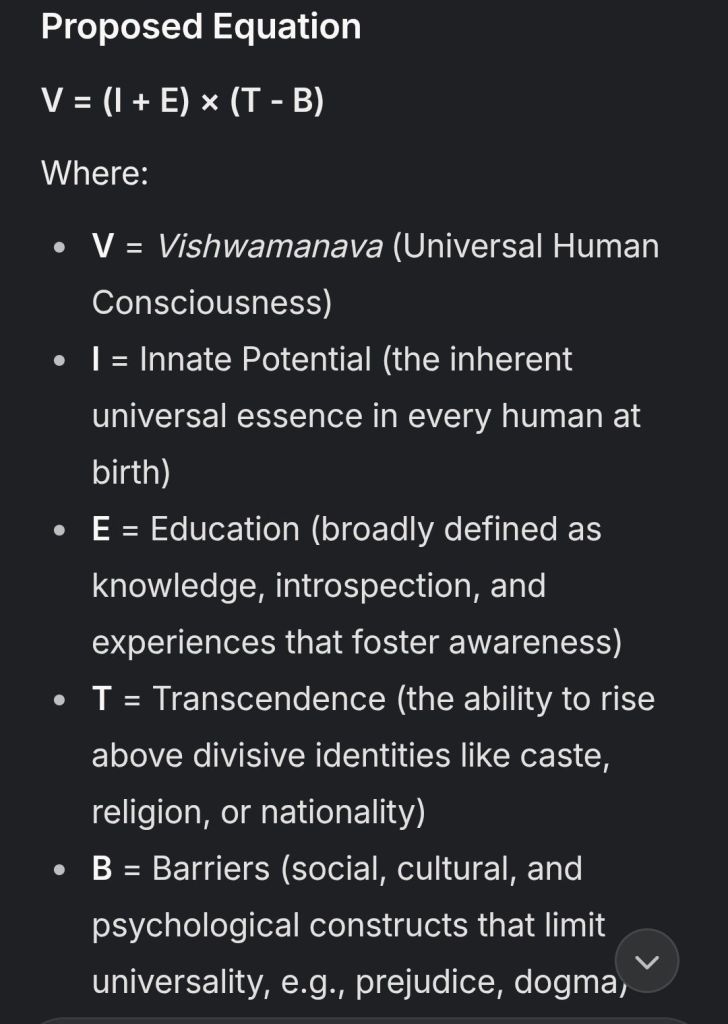
Proposed Equation
V = (I + E) × (T – B) [The VishwaManava Equation].
Where:
- V = Vishwamanava (Universal Human Consciousness)
- I = Innate Potential (the inherent universal essence in every human at birth)
- E = Education (broadly defined as knowledge, introspection, and experiences that foster awareness)
- T = Transcendence (the ability to rise above divisive identities like caste, religion, or nationality)
- B = Barriers (social, cultural, and psychological constructs that limit universality, e.g., prejudice, dogma)
Explanation
- Innate Potential (I): Kuvempu believed humans are born as Vishwamanava—pure, untainted by division. This is the baseline potential for universality.
- Education (E): Education, in its truest sense, includes rational thought, cultural exposure, and self-reflection. It amplifies innate potential by equipping individuals to question and understand beyond their immediate context.
- Transcendence (T): This represents the conscious effort to move beyond limiting identities. It’s the active rejection of boundaries that separate humanity.
- Barriers (B): These are the societal forces—dogma, inequality, or tribalism—that pull toward Alpamanava. Subtracting barriers from transcendence reflects the struggle to overcome them.
- Multiplicative Relationship: The product of (I + E) and (T – B) suggests that both expanded awareness (through potential and education) and the removal of divisive barriers are necessary for Vishwamanava. If either term approaches zero (e.g., no transcendence or overwhelming barriers), V diminishes.
Interpretation
- A high V emerges when someone nurtures their innate potential with meaningful education and actively transcends barriers like prejudice or rigid identities.
- If B (barriers) outweighs T (transcendence), the result is negative or low V, reflecting a slide toward Alpamanava.
- The equation is dynamic, as E, T, and B evolve with personal growth and societal context.
This equation isn’t a literal formula but a symbolic representation of Kuvempu’s vision: Vishwamanava is achieved by cultivating universal potential and dismantling divisions, a process requiring both inner growth and outer action.
*Community Invited for Egalitarians & global Fillosofers & Philosophies:*
 GRP_VCare2Dare