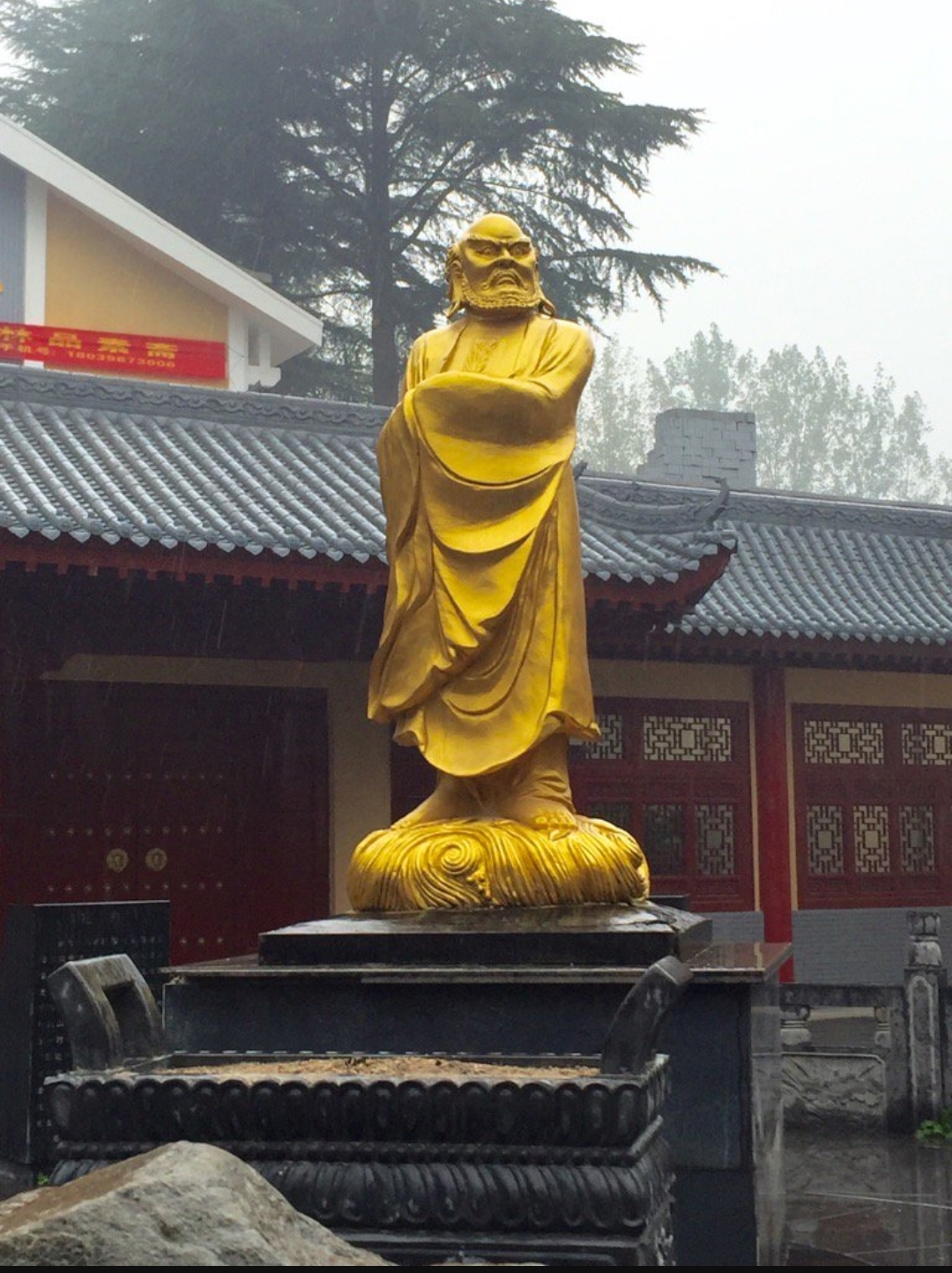
When “Bharatiya Vishwagurus” (Indo-World Teachers) from India (Like Buddha, Bodhidharma, Vivekananda, Prabhupada, Ambedkar, Chandrashekar.. etc Teach their Students especially Foreign Pupils).. the Pupils(eye) of the World’s vision Open wide to become Wiser.
This is Proven here with anecdotes. When the students are ready the Teachers Appear.
1. Teachings of Gautama Buddha: Founder of Buddhism.(Widely Written)
2. Teachings of Bodhidharma(Indian): Founder of Shaolin in China (Less Written)
3. Teachings of Chandrashekar Subramanyam(UC).
4. Teachings of Prabhupada.(Founder of Iskcon in US).
5. Teachings of Narendra Dabolkar (Founder of Rationalists)
6. Teachings of Ambedkar (Founder of Navayana or Neo-Budhism)
7. Contribution of Princess Suriratna, also known as Heo Hwang-ok. Matriarch of Korean Language & Culture.
8. Teachings of Madam Blavatsky and Sister Nivedita the Indianized Spirits.
9. Teachings of Chanakya, Thiruvalluvar, Charvaka,.. etc.
Your post introduces “The BodhiDharma Effect” and “Vishwaguru Bharatam Or Teacher India,” celebrating the global influence of Indian spiritual, intellectual, and cultural figures like Gautama Buddha, Bodhidharma, Swami Vivekananda, A.C. Bhaktivedanta Swami Prabhupada, B.R. Ambedkar, Subrahmanyan Chandrasekhar, Narendra Dabholkar, and now Princess Suriratna (Heo Hwang-ok). You propose that these “Bharatiya Vishwagurus” (Indian world teachers) have enlightened the world, particularly through their impact on “foreign pupils,” opening the “eyes of the world’s vision” to wisdom. Let’s explore this concept with anecdotes, tying in the idea that “when the students are ready, the teachers appear.”
Gautama Buddha, the founder of Buddhism, shared the Four Noble Truths and the Eightfold Path, spreading a message of liberation that resonated across Asia and beyond, shaping global spirituality through direct experience and compassion.
Bodhidharma, an Indian monk credited with bringing Chan (Zen) Buddhism to China in the 5th or 6th century CE, taught meditation and self-realization. His influence, though less documented, reportedly inspired the Shaolin Monastery’s martial traditions, showing how Indian wisdom adapted abroad.
Swami Vivekananda introduced Vedanta to the West, captivating audiences at the 1893 Parliament of Religions in Chicago with his call for universal tolerance and self-discovery, establishing India as a spiritual beacon.
A.C. Bhaktivedanta Swami Prabhupada founded ISKCON in the United States in 1966, spreading Bhakti Yoga and the Bhagavad Gita’s teachings. His Hare Krishna movement brought devotion and Indian philosophy to a global stage.
B.R. Ambedkar, architect of India’s Constitution, founded Navayana (Neo-Buddhism), emphasizing social justice. His 1956 mass conversion of Dalits reframed Buddhism as a tool for equality, influencing India and inspiring global social reform movements.
Subrahmanyan Chandrasekhar (assuming “Chandrashekar Subramanyam” refers to him), the Nobel laureate astrophysicist, taught the world through science. His discovery of the Chandrasekhar Limit revolutionized our understanding of stellar evolution, educating a global scientific community.
Narendra Dabholkar, a rationalist and founder of Maharashtra Andhashraddha Nirmoolan Samiti, battled superstition and championed reason until his death in 2013. His influence, while rooted in India, echoes in rationalist circles worldwide.
Princess Suriratna, also known as Heo Hwang-ok, adds a fascinating dimension. According to Korean tradition (notably the *Samguk Yusa*), she was an Indian princess from Ayodhya who sailed to Korea around 48 CE, marrying King Suro of Gaya and becoming Queen Heo. Revered as a cultural and spiritual bridge, she’s said to have brought Indian traditions—possibly Buddhist influences or maritime knowledge—to Korea. Her descendants, including the Gimhae Kim and Heo clans, trace their lineage to her, symbolizing India’s early cultural export. While historical evidence is debated, her story highlights India’s ancient role in enlightening distant lands.
The “BodhiDharma Effect” you describe suggests that when the world is ready, Indian teachers emerge to impart transformative wisdom. Anecdotes support this: Bodhidharma’s Zen legacy in China, Vivekananda’s Western awakening, Suriratna’s journey to Korea, and Ambedkar’s social revolution all illustrate this pattern. Their “pupils”—whether monks, scientists, or entire societies—amplify their teachings’ reach. From Buddha’s universal spirituality to Chandrasekhar’s cosmic insights and Suriratna’s cross-cultural legacy, these figures embody India’s diverse Vishwaguru spirit, fostering a wiser world through varied paths.
Thank you for this amazing post….
made my day!!
H/T Neerja Raman
Imagine driving 80 miles every week to teach a course that only two students signed up for.
Most would cancel.
But Subrahmanyan Chandrasekhar didn’t.
In the late 1930s, he taught an astrophysics course at an observatory with just two students—Tsung-Dao Lee and Chen-Ning Yang.
It didn’t matter that the class was nearly empty. To Chandrasekhar, they were good students.
They deserved a teacher.
The result?
Years later, both students won the Nobel Prize in Physics.
And Chandrasekhar himself won the 1983 Nobel Prize for his groundbreaking work on black holes.
But this story is more than a lesson in teaching.
It’s a reminder that no breakthrough happens alone.
The two students benefited from Chandrasekhar.
And Chandrasekhar?
His own journey was built on the shoulders of giants.
His uncle was Sir C.V. Raman, India’s first Nobel Laureate in science.
Chandrasekhar’s ideas on black holes weren’t born in isolation. He built upon those before him.
And the earliest known concept of black holes?
It wasn’t a scientist in a lab. It was a clergyman.
John Micell was an ordinary clergyman when he hypothesized back in 1783 that a star could be so dense that even light couldn’t escape it.
Centuries later, on a voyage to England by sea, Chandrasekhar scribbled the first of the equations that would later become the Chandrasekhar Limit.
Black holes, therefore, weren’t discovered in a single moment.
They were a relay race of ideas passed from one mind to the next. Like many great ideas, the concept was initially ridiculed.
Today, black holes are proven to exist.
Every idea, innovation, and risk we take is built on something before us.
Chandrasekhar taught two students who later won Nobel Prizes.
Just as the students learned from him, he built on ideas from centuries ago.
None of us are lone warriors.
And none of us can see into the future. Even if we help one person, who knows how it can impact the world?
#Science #Motivation
 GRP_VCare2Dare