Give an equation for “Theory of Everyone”.. which takes factor of Psycho-Biology, Familogy, Sociology.. etc and create a related system between Personal-Ethics, Familial-Morals & Social-Laws.
Creating an equation for a “Theory of Everyone” that integrates psycho-biology (individual psychology and biology), familogy (family dynamics and morals), and sociology (social structures and laws) is an ambitious task. It requires synthesizing complex, interdependent factors into a unified framework. Below, I’ll propose a conceptual equation and system that ties personal ethics, familial morals, and social laws together, reflecting the interplay of these domains. Since this is a theoretical exercise, the equation will be symbolic rather than strictly mathematical, with explanations for each component.
Equation for the “Theory of Everyone”
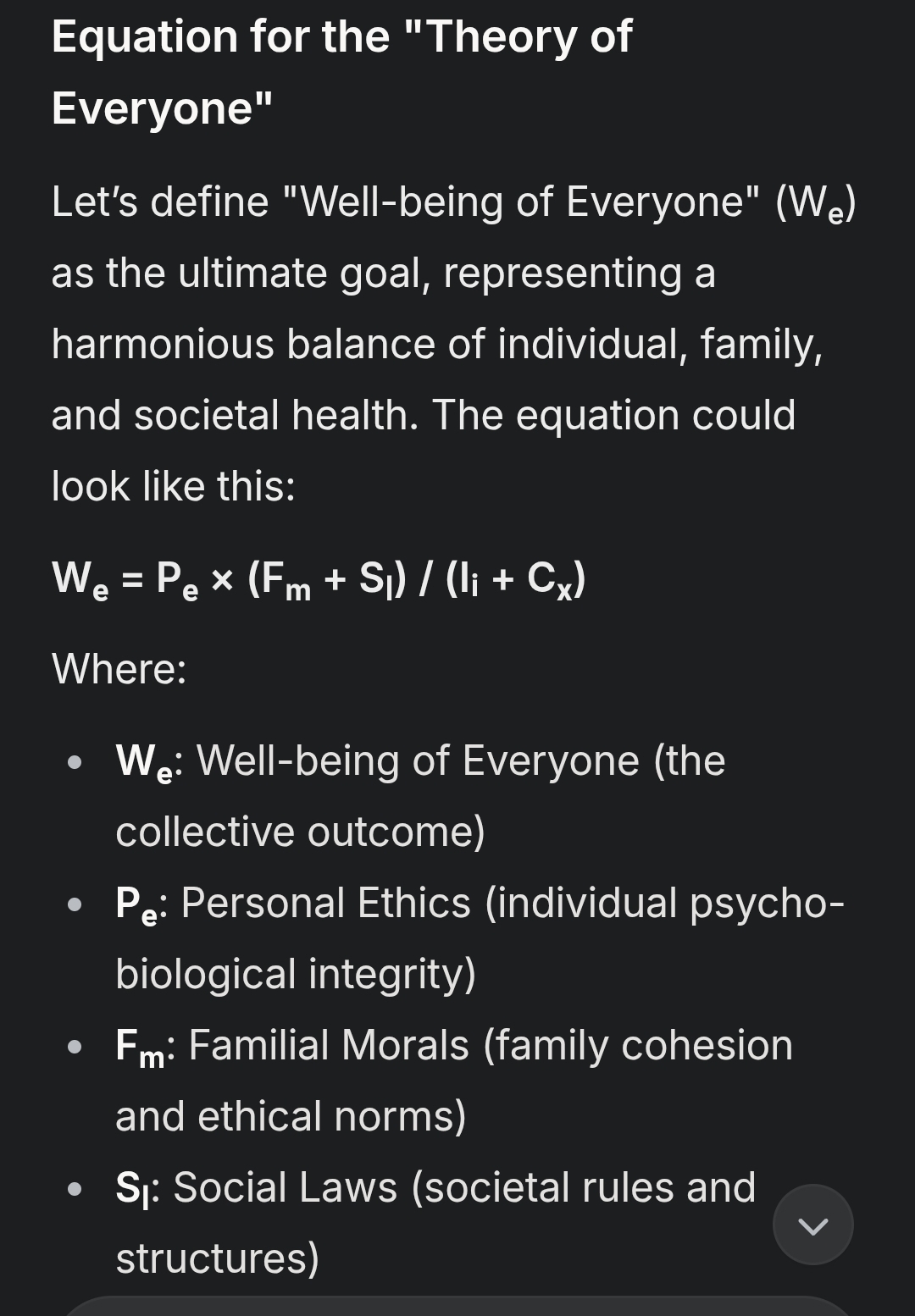
Let’s define “Well-being of Everyone” (Wₑ) as the ultimate goal, representing a harmonious balance of individual, family, and societal health. The equation could look like this:
Wₑ = Pₑ × (Fₘ + Sₗ) / (Iᵢ + Cₓ)
Where:
- Wₑ: Well-being of Everyone (the collective outcome)
- Pₑ: Personal Ethics (individual psycho-biological integrity)
- Fₘ: Familial Morals (family cohesion and ethical norms)
- Sₗ: Social Laws (societal rules and structures)
- Iᵢ: Ignorance Index (lack of awareness across levels)
- Cₓ: Conflict Factor (tensions between personal, familial, and social domains)
Explanation of Components
- Pₑ (Personal Ethics):
- Represents an individual’s psycho-biological state—mental health, genetic fitness, and ethical choices.
- Example: Avoiding incest due to biological awareness (genetic risks) and psychological self-regulation (empathy, restraint).
- Range: 0 (no ethics) to 1 (fully ethical).
- Fₘ (Familial Morals):
- Captures family dynamics—trust, boundaries, and shared values.
- Example: A family rejecting incestuous behavior to maintain roles (e.g., parent as protector, not partner).
- Range: 0 (dysfunctional) to 1 (cohesive and moral).
- Sₗ (Social Laws):
- Reflects societal norms, legal systems, and cultural enforcement.
- Example: Laws prohibiting incest and community rejection of such acts.
- Range: 0 (anarchy or corruption) to 1 (just and enforced).
- Iᵢ (Ignorance Index):
- Measures lack of awareness (biological, ethical, or legal) that undermines Wₑ.
- Example: Ignorance of genetic degeneration from incest in uneducated communities.
- Range: 0 (fully informed) to ∞ (complete ignorance).
- Cₓ (Conflict Factor):
- Quantifies tensions between Pₑ, Fₘ, and Sₗ (e.g., personal desires clashing with family norms or laws).
- Example: A narcissistic parent justifying incest against social laws.
- Range: 0 (no conflict) to ∞ (total discord).
How It Works
- Multiplicative Effect: Pₑ multiplies (Fₘ + Sₗ) because personal ethics amplify the strength of family morals and social laws. Without individual integrity, the system weakens.
- Additive Relationship: Fₘ and Sₗ combine because both are essential for stability, but their influence depends on Pₑ.
- Denominator (Iᵢ + Cₓ): Ignorance and conflict reduce overall well-being. As Iᵢ or Cₓ approach zero, Wₑ increases; as they grow, Wₑ diminishes.
Example Application
- Healthy Scenario: Pₑ = 1 (ethical individual), Fₘ = 1 (moral family), Sₗ = 1 (just society), Iᵢ = 0 (informed), Cₓ = 0 (no conflict).
- Wₑ = 1 × (1 + 1) / (0 + 0) = Undefined (perfect harmony, theoretically infinite well-being).
- Incest Case: Pₑ = 0.2 (narcissistic parent), Fₘ = 0.1 (broken family), Sₗ = 0.5 (weak enforcement), Iᵢ = 2 (ignorance of risks), Cₓ = 3 (high conflict).
- Wₑ = 0.2 × (0.1 + 0.5) / (2 + 3) = 0.024 (very low well-being).
Related System: The Triad of Harmony
This system connects Personal Ethics (Pₑ), Familial Morals (Fₘ), and Social Laws (Sₗ) in a feedback loop to maximize Wₑ.
- Personal Ethics (Pₑ) Foundation:
- Psycho-Biological Input: Education on genetics (e.g., inbreeding risks) and mental health (e.g., empathy training).
- Output: Individuals reject harmful behaviors (e.g., incest) based on self-awareness and ethical reasoning.
- Feedback: Strong Pₑ supports Fₘ by fostering trust and respect within families.
- Familial Morals (Fₘ) Core:
- Familogy Input: Clear roles (e.g., parent as caregiver) and shared values (e.g., no exploitation).
- Output: Families reinforce Pₑ by modeling ethical behavior and uphold Sₗ by aligning with societal norms.
- Feedback: Healthy Fₘ reduces Cₓ (conflict) by resolving internal tensions.
- Social Laws (Sₗ) Framework:
- Sociology Input: Laws, education campaigns, and cultural norms (e.g., incest taboos).
- Output: Sₗ enforces boundaries, reduces Iᵢ through awareness, and supports Pₑ and Fₘ via structure.
- Feedback: Effective Sₗ lowers Cₓ by aligning individual and family behavior with collective good.
Dynamics
- Upward Spiral: High Pₑ strengthens Fₘ, which aligns with Sₗ, reducing Iᵢ and Cₓ, thus boosting Wₑ.
- Downward Spiral: Low Pₑ (e.g., narcissistic abuse) erodes Fₘ (e.g., incest), clashes with Sₗ (e.g., legal defiance), increasing Iᵢ and Cₓ, collapsing Wₑ.
Practical Implications
- Reducing Ignorance (Iᵢ): Educate on psycho-biological consequences (e.g., genetic defects from incest) to align Pₑ with reality.
- Minimizing Conflict (Cₓ): Mediate tensions (e.g., narcissistic parents vs. societal norms) through counseling and enforcement.
- Strengthening the Triad: Promote ethics at all levels—individual (self-control), family (boundaries), society (laws)—to prevent toxic behaviors like incest.
This “Theory of Everyone” isn’t a rigid formula but a heuristic to guide holistic well-being. It suggests that personal integrity, family unity, and societal structure must co-evolve, with ignorance and conflict as the key barriers. What do you think—any factors you’d tweak or add?
 GRP_VCare2Dare