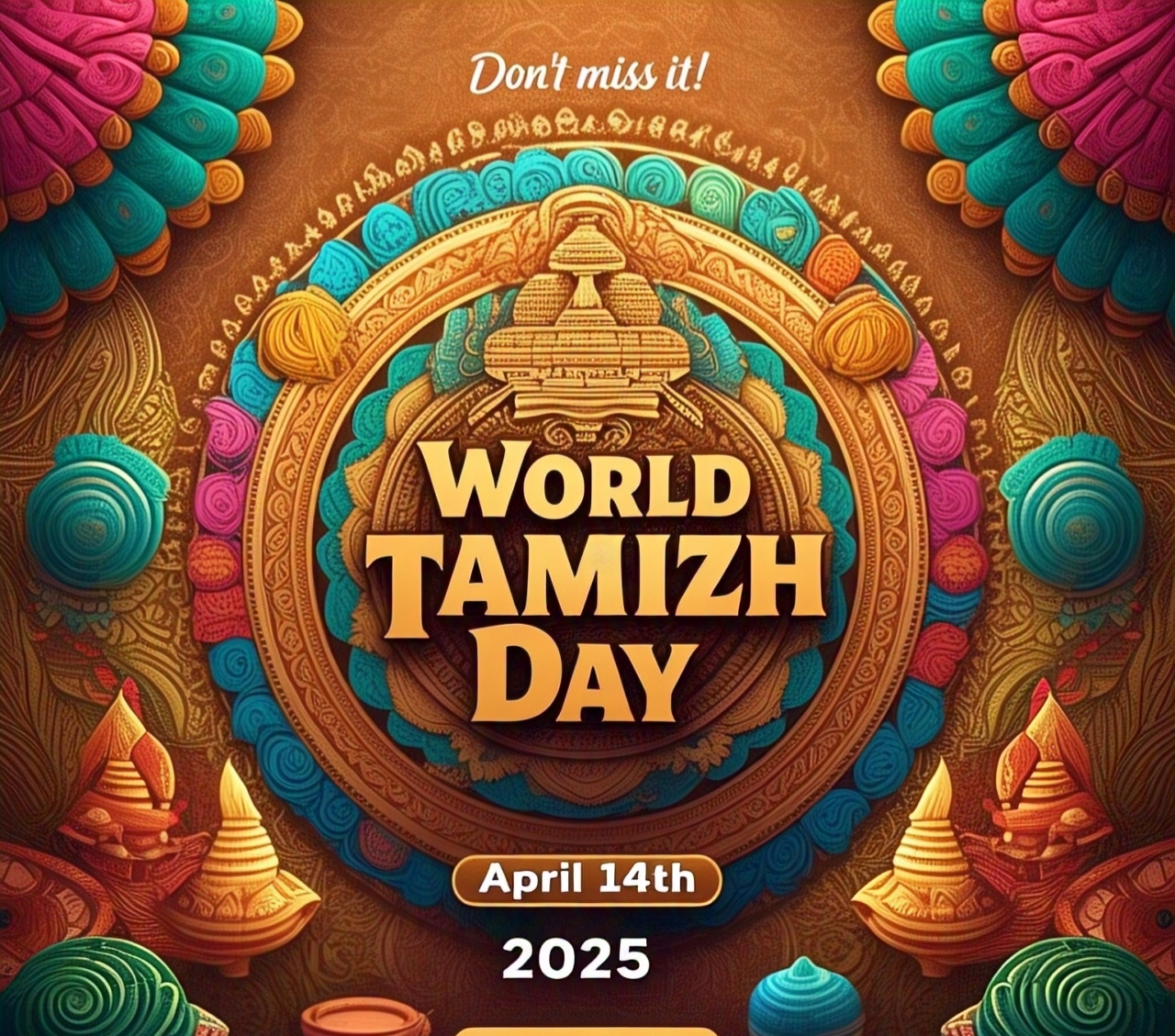
Tamizh Puthandu as World Tamizh Day April 14th.
The Global Relevance of Tamizh Language and Culture: Celebrating April 14 as World Tamizh Day
Introduction
April 14, celebrated as Tamizh New Year or Puthandu, marks a vibrant moment in the Tamizh calendar, symbolizing renewal, unity, and cultural pride for Tamizh communities worldwide. Beyond its regional significance, the Tamizh language and culture hold profound global relevance, rooted in their ancient heritage, literary richness, and universal values. This article explores why Tamizh language and culture resonate globally and advocates for designating April 14 as World Tamizh Day to honor its contributions to humanity.
The Timeless Legacy of Tamizh Language
Tamizh is one of the world’s oldest living languages, with a documented history spanning over 2,500 years. Recognized as a classical language by India in 2004, its continuity is remarkable, with ancient texts like Tolkāppiyam (a grammatical treatise) and Thirukkural (a moral and ethical guide) still studied and revered today. Unlike many ancient languages relegated to history, Tamizh remains a vibrant medium of communication for over 80 million native speakers across India, Sri Lanka, Malaysia, Singapore, and diaspora communities in North America, Europe, and Australia.
The language’s global footprint is evident in its adaptability. Tamizh has embraced modern contexts—used in technology, cinema, and digital media—while preserving its linguistic purity. Its phonetic script, with 247 characters, is one of the most systematic writing systems, influencing linguistic studies worldwide. For instance, Tamizh’s syllabic structure has inspired computational linguistics, aiding natural language processing models for Dravidian languages.
Tamizh Culture: A Universal Tapestry
Tamizh culture is a mosaic of art, literature, music, dance, and philosophy, deeply rooted in values of equality, compassion, and harmony. The Sangam literature (300 BCE–300 CE), comprising 2,381 poems, reflects a society that celebrated love, valor, and ecological balance—ideas that resonate with global movements for sustainability and humanism today. The Thirukkural, penned by Thiruvalluvar, offers 1,330 couplets on ethics, governance, and love, translated into over 80 languages, making it a universal manual for righteous living. Leaders like Mahatma Gandhi drew inspiration from its teachings, underscoring its cross-cultural impact.
Tamizh performing arts, such as Bharatanatyam and Carnatic music, have transcended borders. Bharatanatyam, with its intricate gestures and storytelling, is performed globally, from Sydney to New York. Carnatic music’s emphasis on improvisation and emotional depth has influenced jazz and world music, with artists like Ravi Shankar bridging Tamizh traditions to international audiences. Festivals like Pongal and Puthandu emphasize gratitude and renewal, aligning with global values of community and resilience.
Tamizh Diaspora: A Global Bridge
The Tamizh diaspora, estimated at over 10 million, has carried the language and culture to every continent. In countries like Malaysia, where Tamizh is an official minority language, and Singapore, where it is one of four national languages, Tamizh thrives in education and media. In Canada and the UK, Tamizh schools and cultural organizations foster linguistic pride among second-generation Tamizhs. This global presence amplifies Tamizh’s role as a cultural ambassador, promoting diversity and intercultural dialogue.
The diaspora’s contributions extend beyond culture. Tamizh professionals in technology, medicine, and academia—think of Sundar Pichai, CEO of Google, or Nobel laureate Venkatraman Ramakrishnan—reflect the community’s global influence. Their success underscores Tamizh values of education and perseverance, inspiring youth worldwide.
Why April 14 as World Tamizh Day?
Designating April 14 as World Tamizh Day would celebrate Tamizh language and culture’s enduring contributions while fostering global unity. Puthandu, falling on April 14 in the Gregorian calendar (based on the Tamizh solar calendar), is a day of joy, reflection, and cultural expression. It aligns with spring festivals globally, symbolizing renewal—a universal theme. Recognizing this date internationally would:
- Promote Linguistic Diversity: UNESCO estimates half of the world’s 7,000 languages may vanish by 2100. Celebrating Tamizh, a thriving ancient language, highlights the importance of preserving linguistic heritage.
- Honor Universal Values: Tamizh culture’s emphasis on ethics, equality, and harmony aligns with global goals like the UN’s Sustainable Development Agenda, encouraging cross-cultural learning.
- Unite Communities: A global Tamizh Day would connect Tamizh speakers and enthusiasts, from Chennai to Toronto, fostering pride and collaboration.
- Inspire Cultural Exchange: Events like Tamizh literary festivals, dance recitals, or Thirukkural readings could engage non-Tamizhs, promoting mutual understanding.
A Vision for Celebration
Envision World Tamizh Day as a global festival: schools teaching Thirukkural couplets, theaters showcasing Bharatanatyam, and digital platforms streaming Tamizh music. Universities could host symposia on Sangam poetry’s ecological insights, while communities organize kolam (rangoli) contests symbolizing creativity. Such celebrations would amplify Tamizh’s soft power, much like International Yoga Day has for Indian philosophy.
Conclusion
Tamizh language and culture are not mere relics of the past but living bridges to a global future. Their literary depth, artistic brilliance, and ethical wisdom offer timeless lessons for humanity. By celebrating April 14 as World Tamizh Day, we honor a heritage that unites millions while inviting the world to share in its beauty and values. Let this day be a clarion call for cultural pride, linguistic diversity, and global harmony—a true Puthandu for all.
 GRP_VCare2Dare