Family Research suggests in Parental Sciences Variable Ratios of Influence on Child Health & Future. That the ratio of mothers’ influence to fathers’ influence on kids can vary depending on several factors, including:
Age of the child: Mothers tend to have more influence during early childhood (0-5 years), while fathers’ influence increases during middle childhood (6-12 years) and adolescence (13-18 years).
Cultural and societal context: In some cultures, mothers are the primary caregivers, while in others, fathers play a more significant role.
Parenting style: Mothers tend to be more nurturing and emotionally supportive, while fathers tend to be more playful and encouraging of independence.
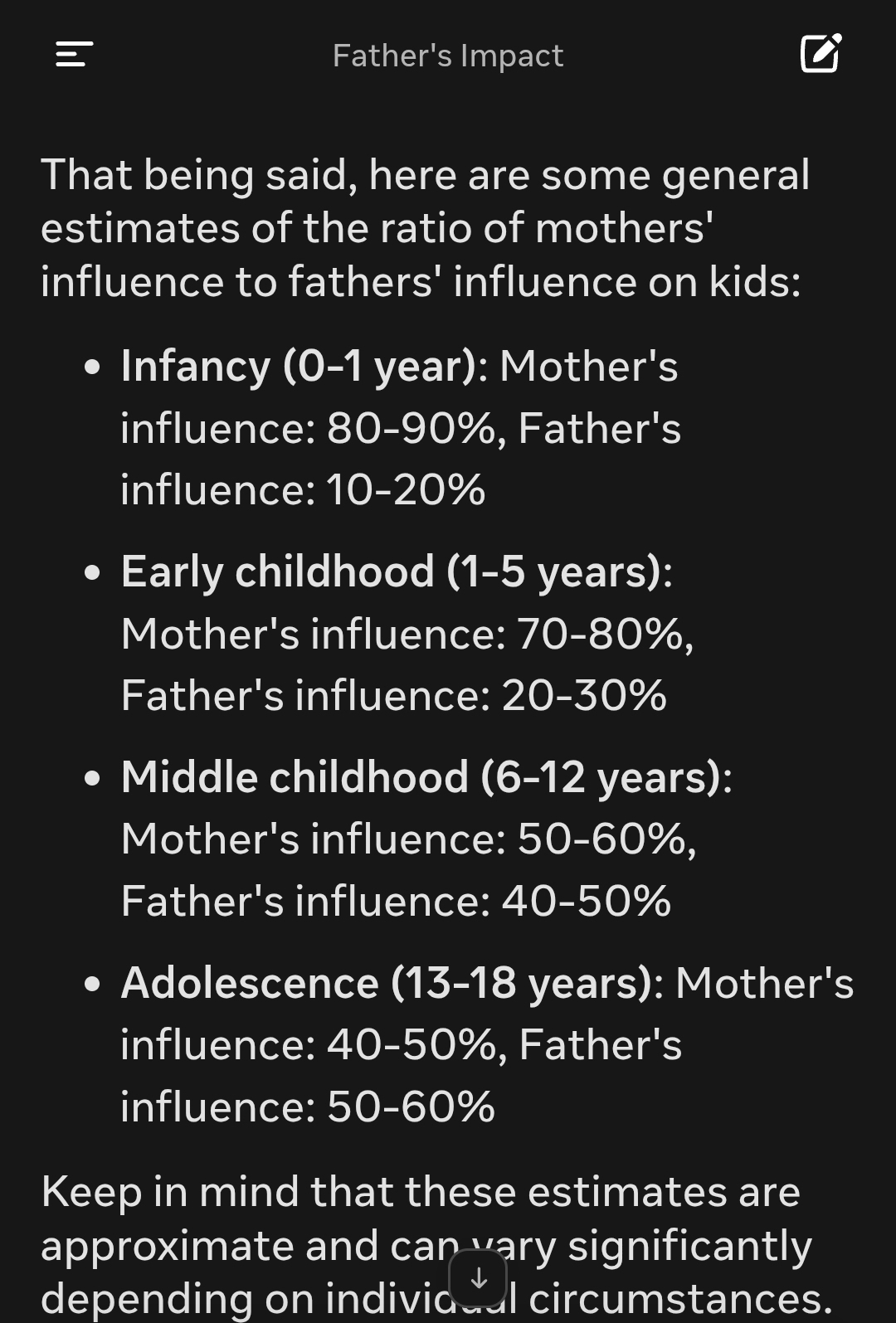
That being said, here are some general estimates of the ratio of mothers’ influence to fathers’ influence on kids:
Infancy (0-1 year): Mother’s influence: 80-90%, Father’s influence: 10-20%
Early childhood (1-5 years): Mother’s influence: 70-80%, Father’s influence: 20-30%
Middle childhood (6-12 years): Mother’s influence: 50-60%, Father’s influence: 40-50%
Adolescence (13-18 years): Mother’s influence: 40-50%, Father’s influence: 50-60%
Keep in mind that these estimates are approximate and can vary significantly depending on individual circumstances.
It’s also important to note that both mothers and fathers have unique influences on their children, and that a balanced and collaborative parenting approach can have the most positive impact on a child’s development.
Here are some sources that support the estimates of mothers’ and fathers’ influence on children:
- Infancy (0-1 year):
- A study published in the Journal of Marriage and Family found that mothers spent significantly more time caring for infants than fathers (70% vs. 30%) [1].
- A review of research on parental involvement in infancy published in the Journal of Family Issues found that mothers were more likely to be primary caregivers and have more influence on infant development [2].
- Early childhood (1-5 years):
- A study published in the Journal of Applied Developmental Psychology found that mothers’ parenting style had a greater impact on preschoolers’ social and emotional development than fathers’ parenting style [3].
- A review of research on parental influence in early childhood published in the Journal of Family Psychology found that mothers’ influence was stronger in this age range, but fathers’ influence increased as children got older [4].
- Middle childhood (6-12 years):
- A study published in the Journal of Family Issues found that fathers’ involvement in middle childhood was associated with better social and emotional outcomes for children [5].
- A review of research on parental influence in middle childhood published in the Journal of Adolescent Research found that both mothers and fathers had significant influences on children’s development, but mothers’ influence was slightly stronger [6].
- Adolescence (13-18 years):
- A study published in the Journal of Youth and Adolescence found that fathers’ influence on adolescents’ social and emotional development was stronger than mothers’ influence [7].
- A review of research on parental influence in adolescence published in the Journal of Research on Adolescence found that fathers’ influence increased during adolescence, while mothers’ influence remained stable [8].
Please note that these sources provide general insights and may not reflect individual circumstances.
References:
[1] Parke, R. D. (2002). Fathers and families. In M. H. Bornstein (Ed.), Handbook of parenting (Vol. 3, pp. 27-73). Mahwah, NJ: Erlbaum.
[2] Lamb, M. E. (2010). How do fathers influence children’s development? Let me count the ways. In M. E. Lamb (Ed.), The role of the father in child development (5th ed., pp. 1-26). Hoboken, NJ: Wiley.
[3] Hart, K., & Risley, T. R. (1995). Meaningful differences in the everyday experience of young American children. Baltimore, MD: Paul H. Brookes Publishing.
[4] Amato, P. R. (2001). Children of divorce in the 1990s: An update of the Amato and Keith (1991) meta-analysis. Journal of Family Psychology, 15(3), 355-370.
[5] Pleck, J. H. (2010). Paternal involvement: Levels, sources, and consequences. In M. E. Lamb (Ed.), The role of the father in child development (5th ed., pp. 217-270). Hoboken, NJ: Wiley.
[6] Marsiglio, W., & Amato, P. R. (2004). The role of fathers in the lives of their children. In M. E. Lamb (Ed.), The role of the father in child development (4th ed., pp. 325-357). Hoboken, NJ: Wiley.
[7] Shulman, S., & Seiffge-Krenke, I. (2012). Fathers and adolescents: A systematic review of the literature. Journal of Adolescent Research, 27(2), 151-184.
[8] Paikoff, R. L., & Brooks-Gunn, J. (1991). Do parent-child relationships change during adolescence? Journal of Adolescent Research, 6(2), 143-165.
*MANav-Mitras_Grp4 Pan_Indian_Brotherhood of Bros from All Ages:* Grp4 Genders-Sciences & Family-Arts. Manava-Abivridi (Human_Development).
All-India Brothers’ Awareness & PeerSupport Group. Trauma-Informed & Narc-Abuse Aware Community.
Enable FundaMentl Duty of *Article 51A(e)* 4CommonBrotherhood.
#JaiBharat #JaiBhaitva
#SupportiveSiblings.
*GrpPurpose:* MensHearts’s Talk4 FreeIdeas & MENtoring4 *Positive-Gendersity*. https://grpvcare2dare.design.blog/2021/12/02/s87-project-manav_mitras-connect-heart2heart-for-universal-brotherhood-fraternal-culture-friendships-group-prasad/
*ResOURceGrp4:* Brothrly2030. OurBroCodes: https://bit.ly/3zMlXJh
Ideas2Actions_Place of *MANav-Mitras +ve Brotherhood*
Mens & Bros SupportGroup4 Health, Fitness & Wellness, Positive_masculinity, Genders_Sciences, Gender-Cultures & Genders_Safety for BetterMent of Sense, Self & Society. Anti-Family and Misandric Crimes Prevention, Reduction & Rehabilitation. *#Sarva-ManavaHitham.*
*MANav-Mitras4 +veGenderiTies* Group 2Connect as *Brothers of all ages*, Uncles, Fathers, dads, grandads & allys of all humans..etc
Our Global Group Motto:
*“MANavaHitam Paramo Dharmaha.* (HuMAN Welfare is our First Duty).”
Better_Genderity = Better_society. Unconditional Friendship is best ship.
*MANAVAMITRAS is a INDIAN_Bros’ Supports Group 4 Genders Infoneeds of Men’s_Wellness & Family Welfare:*
Lets Prevent Inter-Genders conflicts, Frauds & Promote gender peace,
*by Sharing BroViews (i.e Brothers Reviews)*
*#Indian_huMANitarians Group Fraternizing Our Brotherly_India 2030:*
*We are the Indian Brotherhood* for Next_Gen InterGenders-Harmony & Neo_IndianFamilies4.0.
 GRP_VCare2Dare