Karnataka State-Level Essay Competition :(Open 2 All KSLU Colleges Conducted By VV Sangha’s Vunki Sannarudrappa College Ballari. Opportunity Courtesy & Credits to: Bengaluru Law College, Bengaluru).
Topic: Is Sedition Law Antithetical To Freedom And Democracy?
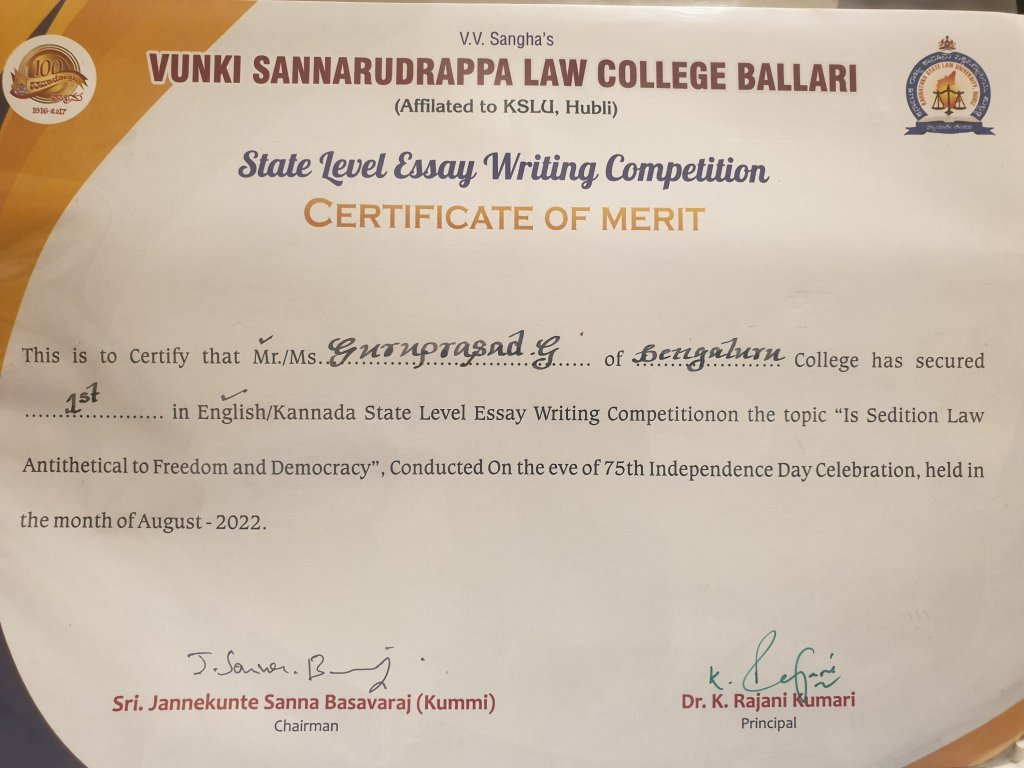
This Essay Won the First Place in a State Level Essay Writing Competition. -Authored by_Guru Prasad. G.
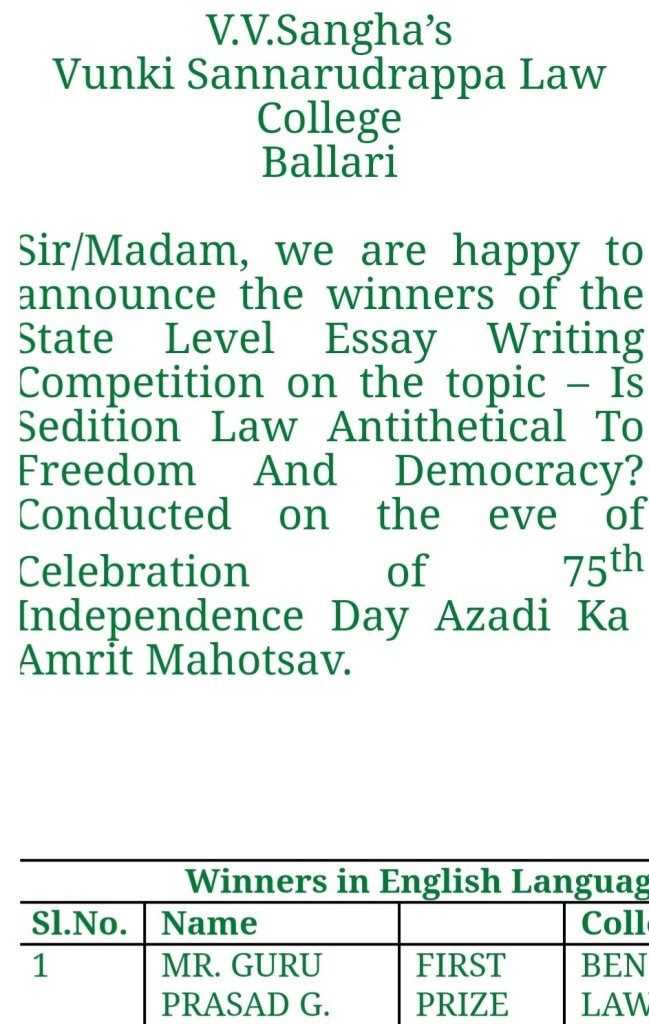
The Essay Titled: Sedition laws; Protecting the State’s Freedom and Citizen’s Democracy.
“Good and just society is neither the thesis of capitalism nor the antithesis of communism, but a socially conscious democracy which reconciles the truths of individualism and collectivism.” … -Martin Luther King Jr
We the people of India and Asia have two important historical days marking the two most valued ideas that have since become Indian-Ideals, which the world looks up to in India. The two ideals are individual Freedom and collective Democracy. The day that marks Indian freedom in world history is ‘15th August 1947’ our Independence day, its the birth of free India and when the spirit of freedom unchained all Indians. The other day that glorifies Indian democracy is ‘26th January 1950’ i.e our Republic day, the day we gave ourselves democratically our Constitution. The first one was the birthday of a free nation and the second one was when the new nation took its first steps out of the cradle towards our collective Indian expedition as one nation towards one destination. We have come a long and strong way for 75 years in 2022 celebrating the Amruth Mahotsav or Diamond Jubilee year.
The Journey of our mothership India has withstood many storms like the greek-Islamic invasions, European occupations & post the two World Wars, the initial wars with neighbouring countries(Pakistan, East Pakistan & China); the undue influence in Indian politics by Cold war superpowers (US & USSR) and an Internal civic war like situation of the national emergency(1975-1977). India also achieved many milestones on the way to becoming the world’s largest democracy, with other achievements like Nuclear capabilities, Space and air defence capacities, advances in science and technology and commerce made India the knowledge and human resource hub of the world. With all of these, our Indian economy is now the 5th largest in the world, but on the other hand, the Public Justice and WJP rule of law index[1] of India is 69 of 129 countries (Status: partly free). Why this disparity in our Social-Economic indices with our Legal-Humanistic metrics?
One of the main reasons is The Sedition laws are antithetically opposed to modern values of Freedom & Democracy.. and so are few other colonial archaic laws which are protecting the vested interests and freedom of the governmental persons like the elected parliamentarians in power, while simultaneously silencing individual free voices and dissenters by targetted prosecutions of critically aware citizens and impacting the democratic process negatively. Thus making the nation less free and democratic which is showing up in the global metrics [2] and also in the escalating number of Sedition trials and long years of undertrial custody. Given ahead are more arguments, relevant base, articles of the Constitution, Sections of acts and evidence to prove this stance.
History of Sedition laws & Section 124A of IPC
From the time of the ancient monarchial world till the age of Wisdom blossomed Renaissance of Greeks and Romans, the kings and autocratic elites controlled public opinion and dissent in their kingdoms and colonies. In the 17th century, when British parliamentarians in England felt that only positive ideas of the government should exist, they passed seditious laws. They did this because they considered that negative beliefs were harmful to the monarchy and the government. The British appropriated this philosophy and turned it into this law including it in Section 124A of the Indian Penal Code in the year 1870. The British government utilized the Sedition Act for convicting and sentencing freedom fighters like Bal Thilak, Mahatma Gandhi and many more in order to extend the period and power of British colonial occupation.
IPC 124A. Sedition. Reads—Whoever, by words, either spoken or written, or by signs, or by visible representation, or otherwise, brings or attempts to bring into hatred or contempt, or excites or attempts to excite disaffection towards, the Government established by law shall be punished with [imprisonment for life], to which fine may be added, or with imprisonment which may extend to three years, to which fine may be added, or with fine. There are two Explanations to this section i.e Comments about the disapprobation of the administrative measures or any action of the Government with a view to obtain their alteration by lawful means, without exciting or attempting to excite hatred, contempt or disaffection, do not constitute an offence under this section.
Sedition essentially is blatant behaviour that goes toward revolt against the existing order, such as speech and organisation. Subversion of a constitution and instigation of discontent with, or insurgency against, existing authority are common examples of sedition. Any uproar that is not intended at direct and open violence against the laws is not considered sedition. Seditious libel is the use of seditious language in writing.
There is a common confusion between sedition and treason which maybe leading to malicious prosecution & abuse of legal procedure. Sedition is an insurrectionary movement tending towards treason, but wanting an overt act; attempts made by meetings or speeches, or by publications, to disturb the tranquillity of the state. The distinction between “sedition” and “treason” is that though the ultimate object of sedition is a violation of the public peace or measures as evidently engenders it. Yet unlike treason, it does not aim at direct and open violence against the laws or the subversion of the constitution (eg. Naxalism or Maoism).
During the British Raj, the Indian Penal Code was enacted in 1860. The law was drafted in 1837 by British historian and politician Thomas Macaulay, but was surprisingly deleted when the Indian Penal Code (IPC) was implemented in 1860. When Britain recognised the necessity for a separate section to deal with the upraising or rebellious offence, an amendment offered by Sir James Stephen in 1870 inserted Section 124A.
The British administration in India at the time was concerned that Muslim extremist preachers(Khilafats) on the Indian subcontinent might start jihad against it. The need for such legislation became apparent after the British successfully suppressed the Wahabi/Waliullah Movement. This clause was used to oppress national independence campaigners (Moderates Freedom Fighters) throughout the Raj, including Lokmanya Tilak and Savarkar, who were found guilty as per the old sedition law and imprisoned.
The Supreme Court in recent times has placed the onus on the government to guarantee that no frivolous sedition charges are filed to abuse the law, despite the judiciary’s prohibition the conviction rate is mere 2.25%. The Supreme Court stayed the use of the sedition law in May 2022 and directed the Centre and states not to register any fresh FIRs invoking sedition charges until the law is legislatively & democratically reviewed.
In 2018, the Law Commission suggested that sedition should be invoked only in cases where the intention behind any action was to disrupt public order or to overthrow the government with violence and illegal means.
Expression, dissent and criticism are essential ingredients of a robust public debate on policy issues as part of a vibrant democracy. “Therefore, every restriction on free speech and expression must be carefully scrutinised to avoid unwarranted restrictions,” the Law Commission had said.
The Supreme Court’s major legal challenge is whether the 1962 judgement in Kedar Nath Singh v Union of India was correctly decided. Which pointed out that ‘Speech’ that is likely to provoke ‘disruption of public order’ is considered sedition and it affirmed the constitutional validity of Section 124A. A seven-judge panel will have to assess if that verdict was correct and whether a statute against sedition may be considered an exception to free speech. Also, other connected newer acts & legislations may be considered like the Unlawful Activities (Prevention) Amendment Act, 2019 (UAPA 2019) which may serve the purpose of controlling sedition, treason and internal threats to the government and nation.
In this legal evolution of principles of freedom and democracy. The state needs to have good control over radicals for its citizens, especially the actions detrimental to the nation’s sovereignty & integrity. There needs to be reasonable restrictions or censorship of art, poetry and literature which does not align or may be a threat to the public interest or State’s goals & vision as coded in our Indian Constitution.
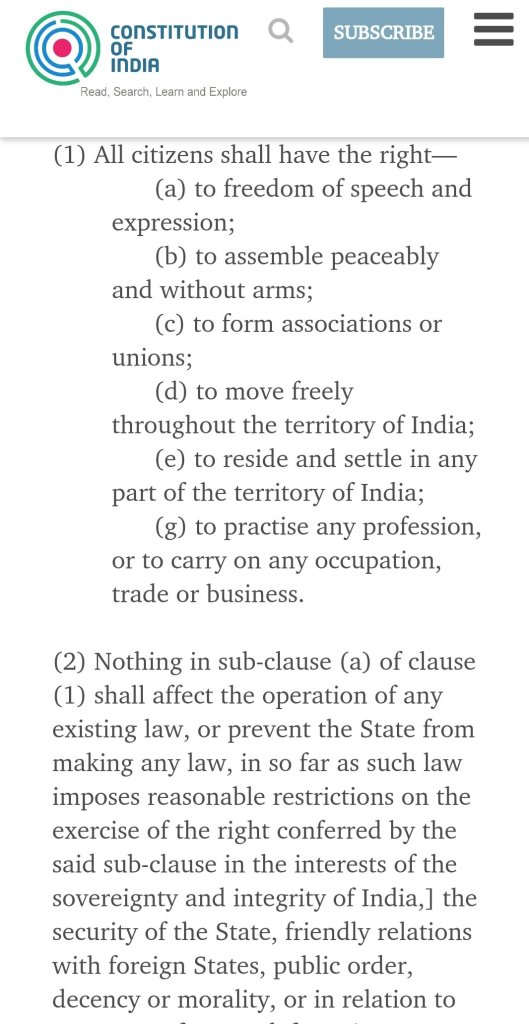
Conflicts with Indian Constitution Article 19 & also Universal Declaration of Human Rights (UNDHR 1948): Indian Constitution in Article 19 provides freedom of speech and expression,
Internationally disregard and contempt for human rights have resulted in barbarous acts which have outraged the conscience of mankind, and the advent of a world in which human beings shall enjoy the freedom of speech, belief and freedom from fear and want. This has been proclaimed as the highest aspiration of citizens. the old Sedition laws of 1870 violate UNDHR in Articles 5(inhuman Torture), 9(Arbitrary arrest) and 10(Fair Public trial). These need to be reviewed also through the lens of International Human Rights laws it needs to be subjected to Doctrine of Eclipse or Severability.
Conclusion.
Individual Freedoms translate to better Collective Democracy. The Current Democracy Index[2] rank of india is 49th rank of 128 countries its close to a Hybrid regimentation with regular electoral frauds, preventing them from being fair and free democracies. The lower ranking nations commonly have governments that apply pressure on political opposition, non-independent judiciaries, widespread corruption, harassment and pressure placed on the media, anaemic rule of law, and more pronounced faults than flawed democracies in the realms of underdeveloped political culture, low levels of participation in politics, and issues in the functioning of governance. Thus this needs to be improved, though the sedition laws may be antithetical, it is a necessary measure that in near future we need to modify for reasonable restrictions in the interest of the nation.
References: 1.https://worldjusticeproject.org/rule-of-law-index/country/2020/India/
2.http://democracyranking.org/wordpress/
3. https://www.un.org/en/about-us/universal-declaration-of-human-rights
4. From International Human Right. https://www.article19.org/
5. From Constitution of India:
Acknowledgements:
I am indebted to many legal and social minds who have inspired, guided and influenced me towards legal-excellence to achieve this prize.
My BLC law college Principal Devika Ajila Madam (Who taught me Constitutional-law), Dean of Academics (Prof. ShivaPrasad Sir) guided me. IPC-Teacher and trustee Prassana Sir discussed about Sedition-law, Radhika Madam labour law teacher.
External positive influences Prof Mohan Gopal sir(NLSIU), Jayaraju Sir(High Court), Deepak(BLC), Kumar(BLC), my classmates and collegemates for their kindness, support and all my legal friends who engage in legal-knoweldge sharing across various groups and places. Like Vinod sir, Sumedha, Hitesh, Virag, Devendra, Ramachandra…, all infinite-teachers (Including my Parents) who have contributed and are contributive to my knowledge and capacity.
They all are SEED-itive and additives to my life. THANK You All.. I am very grateful to all Indian-Hearts.
– Regards Guru Prasad.G
Thanks for reading we are forming a Group Promoting Articles (19, 51A(h) & 28) that is Free-Speech, Scientific-Temper and Secularism: All Critical-Thinking Citizens are welcome to join the Mission for More Rational-India: https://grpvcare2dare.design.blog/2023/03/15/project-saghar-safespaces-for-skeptics-agnostics-humanists-atheists-rationalists-mission_scientific-nations2030/
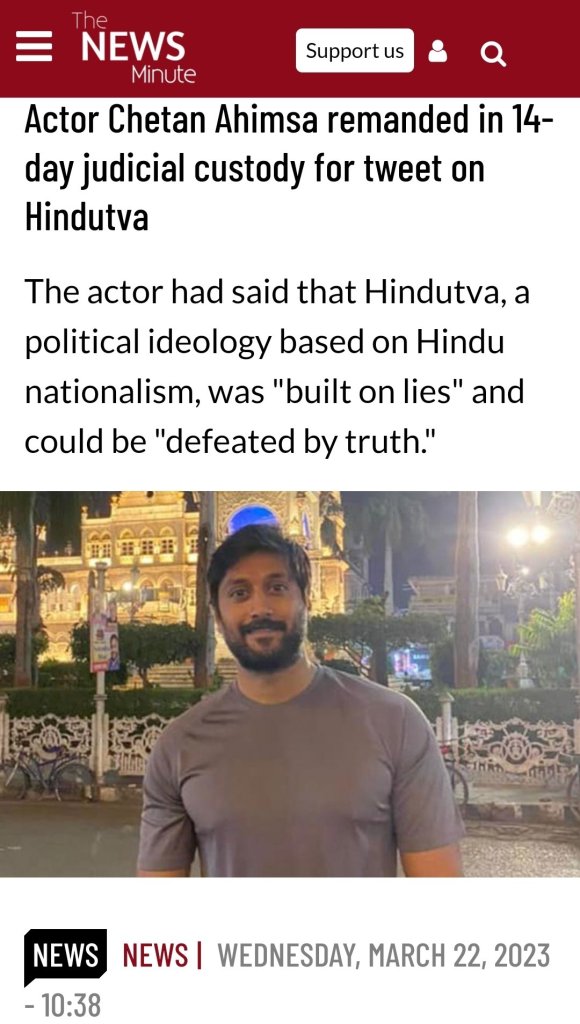
In the interest of freethinking He and everyone has right to give *fair-comments* on any-ism but freedom comes with Personal-Discretion and Reasonable-Restrictions. This is what Diplomacy and Tactful Speech Entails.
But what’s Fair-Comment, reasonable-speech, slander and defamatory speech needs to be understood by every constitutional Citizen.
We wrote this essay on sedition laws which had won 1st place in the state level essay competition in 2022, where these related concepts have been expressed. Presenting here to people so people know where the lines are so all are safer.. request to note where article 19(1) have reasonable restrictions in articles 19(2-6).
https://grpvcare2dare.design.blog/2022/08/19/s186-seditition-laws-protecting-the-states-freedom-and-citizens-democracy/
 GRP_VCare2Dare
One thought on “S186: Sedition laws; Protecting the State’s Freedom and Citizen’s Democracy.”