The Sciences Spectrum along with The Art & humanities Spectrums.
The deep-thinkers see the difference in degrees, where the superficial-thinkers need the binaries as referees.
The spectrum of sciences can be conceptualized as a continuum ranging from Pro-Science, which is grounded in rigorous empirical methods, to Pseudo-Science, which mimics scientific approaches but lacks objectivity, to Anti-Science, which outright rejects scientific principles. Below is a detailed discussion of this spectrum, including definitions, characteristics, examples, and visual representations to illustrate the distinctions.
The Spectrum of Sciences: From Pro-Science to Pseudo-Science to Anti-Science
Overview
The spectrum of sciences reflects the degree to which a discipline or belief system adheres to the principles of the scientific method, which emphasizes objectivity, testability, reproducibility, and falsifiability. This spectrum can be divided into three main categories:
- Pro-Science: Disciplines that rigorously follow the scientific method, relying on empirical evidence, peer review, and objective methodologies.
- Pseudo-Science: Practices that appear scientific but lack the rigor, objectivity, or falsifiability of true science, often blending subjective or untestable claims with scientific terminology.
- Anti-Science: Ideologies or movements that reject scientific methods and findings, often in favor of dogmatic, anecdotal, or conspiratorial beliefs.
Detailed Analysis
1. Pro-Science
Definition: Pro-Science refers to disciplines that adhere strictly to the scientific method, which involves formulating hypotheses, conducting experiments, collecting data, and drawing conclusions based on evidence. These fields are independent of subjective beliefs, whether human or divine, and prioritize objectivity.
Characteristics:
- Empirical Evidence: Conclusions are based on observable, measurable data.
- Falsifiability: Hypotheses can be tested and potentially disproven.
- Peer Review: Findings are scrutinized by experts to ensure validity.
- Reproducibility: Experiments can be repeated with consistent results.
- Transparency: Methods and data are openly shared for scrutiny.
Examples:
- Physics: Studies the fundamental laws of the universe, such as gravity and electromagnetism, using mathematical models and experiments.
- Biology: Investigates living organisms through observation and experimentation, e.g., studying DNA replication.
- Astronomy: Examines celestial bodies and phenomena using telescopes, spectroscopy, and mathematical calculations to understand cosmic events.
Example in Context: Astronomy uses precise measurements of celestial positions and movements to predict events like eclipses with high accuracy, independent of subjective interpretations.
2. Pseudo-Science
Definition: Pseudo-Science involves practices that claim to be scientific but fail to meet the standards of the scientific method. These often incorporate scientific terminology or partial truths but rely on untestable claims, anecdotal evidence, or subjective interpretations.
Characteristics:
- Lack of Falsifiability: Claims cannot be disproven due to vague or untestable assertions.
- Selective Evidence: Uses cherry-picked data while ignoring contradictory evidence.
- Non-Reproducible Results: Findings are inconsistent or cannot be independently verified.
- Appeal to Authority or Tradition: Relies on unverified sources or cultural beliefs rather than evidence.
- Mimics Science: Uses scientific jargon or superficial methodologies to appear credible.
Examples:
- Astrology: Combines astronomical data (e.g., positions of planets) with untestable claims about their influence on human behavior or events. As noted in the user’s example, a prediction like “rain at 7 PM in Bengaluru” based on planetary positions (e.g., “moon and sun in the 5th house with Varuna & Indra Deva”) lacks empirical grounding and cannot be falsified.
- Homeopathy: Claims that highly diluted substances retain therapeutic effects, despite lacking scientific evidence or plausible mechanisms.
- Phrenology: Historically claimed that skull shapes could predict personality traits, a notion debunked by modern neuroscience.
Example in Context: The user’s reference to “Astronomy + Pseudology = Astrology” highlights how astrology uses astronomical observations (e.g., planetary positions) but overlays them with untestable, subjective interpretations, making it pseudo-scientific.
3. Anti-Science
Definition: Anti-Science refers to the outright rejection of scientific methods, evidence, or findings, often in favor of ideological, religious, or conspiratorial beliefs. It denies the validity of the scientific process itself.
Characteristics:
- Rejection of Evidence: Dismisses empirical data in favor of personal beliefs or anecdotes.
- Conspiracy Theories: Attributes scientific findings to hidden agendas or misinformation.
- Dogmatism: Adheres to fixed beliefs that are not open to revision based on evidence.
- Misrepresentation of Science: Misinterprets or distorts scientific findings to fit preconceived notions.
Examples:
- Flat Earth Theory: Rejects overwhelming evidence from astronomy, physics, and geography that the Earth is spherical.
- Anti-Vaccination Movements: Denies the efficacy and safety of vaccines despite extensive clinical trials and epidemiological data.
- Climate Change Denial: Dismisses evidence of human-driven climate change, often citing conspiracies or selective data.
Example in Context: Anti-Science might manifest as rejecting weather forecasting models (based on meteorology) in favor of superstitious beliefs about rain caused by divine or astrological forces, ignoring data from satellites and atmospheric models.
Visual Representation
To illustrate the spectrum, we can represent it as a continuum with key characteristics and examples plotted along it. Below is a description of a chart that visualizes this spectrum, followed by a code snippet to generate it.
Chart 1: Spectrum of Sciences Continuum
This chart places disciplines along a horizontal axis from Pro-Science to Anti-Science, with Pseudo-Science in the middle. The vertical axis represents the degree of adherence to the scientific method.
Description:
- X-Axis: Spectrum from Pro-Science (left) to Pseudo-Science (middle) to Anti-Science (right).
- Y-Axis: Adherence to scientific method (high to low).
- Data Points: Disciplines like Physics, Astronomy, Astrology, and Flat Earth Theory are plotted based on their characteristics.
- Annotations: Key characteristics (e.g., empirical evidence, falsifiability) are highlighted for each category.
import matplotlib.pyplot as plt
import numpy as np
Data for the spectrum
categories = [‘Pro-Science’, ‘Pseudo-Science’, ‘Anti-Science’]
adherence = [90, 50, 10] # Adherence to scientific method (0-100 scale)
x_positions = [1, 2, 3]
Examples for annotation
examples = {
‘Pro-Science’: [‘Physics’, ‘Astronomy’, ‘Biology’],
‘Pseudo-Science’: [‘Astrology’, ‘Homeopathy’, ‘Phrenology’],
‘Anti-Science’: [‘Flat Earth’, ‘Anti-Vax’, ‘Climate Denial’]
}
Create the plot
plt.figure(figsize=(10, 6))
plt.scatter(x_positions, adherence, color=’blue’, s=100)
plt.plot(x_positions, adherence, color=’gray’, linestyle=’–‘, alpha=0.5)
Annotate categories
for i, category in enumerate(categories):
plt.text(x_positions[i], adherence[i] + 5, category, fontsize=12, ha=’center’)
plt.text(x_positions[i], adherence[i] – 10, ‘\n’.join(examples[category]), fontsize=10, ha=’center’)
Customize the plot
plt.title(‘Spectrum of Sciences: Pro-Science to Anti-Science’, fontsize=14)
plt.xlabel(‘Spectrum Position’, fontsize=12)
plt.ylabel(‘Adherence to Scientific Method (%)’, fontsize=12)
plt.xticks([])
plt.grid(True, linestyle=’–‘, alpha=0.7)
plt.ylim(0, 100)
Save and show the plot
plt.savefig(‘spectrum_of_sciences.png’)
plt.show()
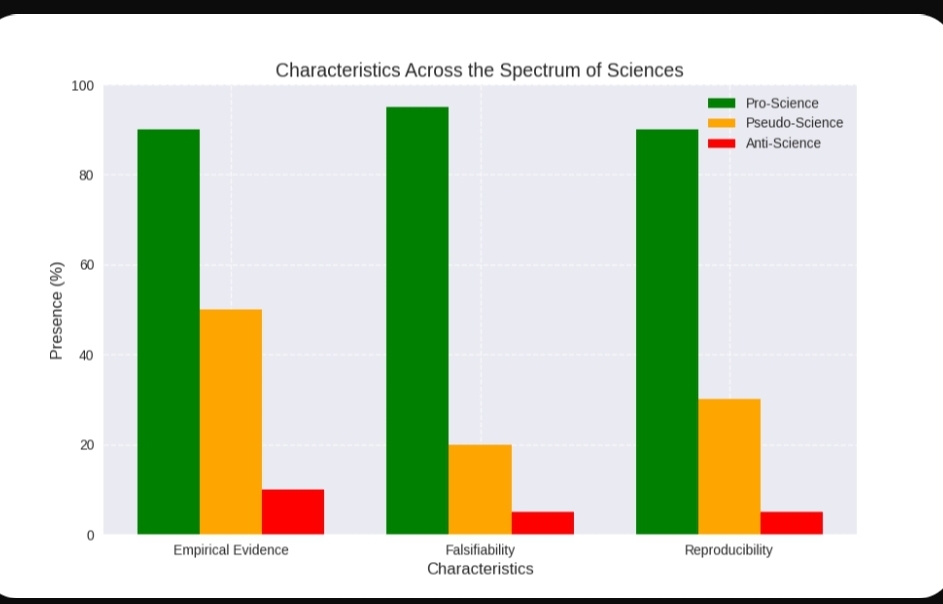
Chart 2: Characteristics Comparison
This chart compares the key characteristics of each category using a bar plot to highlight differences in empirical evidence, falsifiability, and reproducibility.
Description:
- X-Axis: Characteristics (Empirical Evidence, Falsifiability, Reproducibility).
- Y-Axis: Presence of each characteristic (0-100 scale).
- Bars: Separate bars for Pro-Science, Pseudo-Science, and Anti-Science.
import matplotlib.pyplot as plt import numpy as np # Data for characteristics comparison characteristics = ['Empirical Evidence', 'Falsifiability', 'Reproducibility'] pro_science = [90, 95, 90] pseudo_science = [50, 20, 30] anti_science = [10, 5, 5] x = np.arange(len(characteristics)) width = 0.25 # Create the bar plot plt.figure(figsize=(10, 6)) plt.bar(x - width, pro_science, width, label='Pro-Science', color='green') plt.bar(x, pseudo_science, width, label='Pseudo-Science', color='orange') plt.bar(x + width, anti_science, width, label='Anti-Science', color='red') # Customize the plot plt.title('Characteristics Across the Spectrum of Sciences', fontsize=14) plt.xlabel('Characteristics', fontsize=12) plt.ylabel('Presence (%)', fontsize=12) plt.xticks(x, characteristics) plt.legend() plt.grid(True, linestyle='--', alpha=0.7) plt.ylim(0, 100) # Save and show the plot plt.savefig('characteristics_comparison.png') plt.show()
Key Insights
- Pro-Science thrives on objectivity, as highlighted by the user’s comment that science focuses on “objectivity, method, means, and mechanism” independent of subjectivity. Disciplines like astronomy rely on precise, testable data.
- Pseudo-Science, such as astrology, blends scientific elements (e.g., planetary positions) with untestable claims, as seen in the user’s example of predicting rain based on mythological or astrological assertions.
- Anti-Science rejects the scientific method entirely, often dismissing evidence that contradicts preconceived beliefs, such as denying meteorological models in favor of superstition.
Conclusion
The spectrum of sciences illustrates the varying degrees of adherence to the scientific method. Pro-Science builds knowledge through rigorous, objective processes; Pseudo-Science misleads by mimicking these processes without substance; and Anti-Science undermines progress by rejecting evidence altogether. Understanding this spectrum helps distinguish credible science from misleading or harmful alternatives.
 GRP_VCare2Dare